
Launching HATRO to fight the dead internet theory
HATRO is a newsletter for tech creators to source authentic insights. But really, it's a reaction to watching quality content slowly get buried alive.
Inauthentic content is everywhere
Most of the tech content you came across this week was put together, not actually written. Pulled from other articles, pushed through a model, dressed up with a catchy headline, and posted by someone who has never even used the technology they're out here explaining to you.
You probably sensed it. That empty feeling you get after finishing a video and walking away knowing nothing you didn't already know. The blog post breaking down Kubernetes with the same three analogies that every other blog post has already beaten to death. The "expert opinion" that could have been written by absolutely anyone.
This isn't just a content problem. It's a trust problem. And honestly, it keeps getting worse.
Here's what happened. LLM made publishing essentially free. Anyone can now produce a polished 2,000-word article in about four minutes. So people did. Lots of them. The volume exploded. And the algorithms, at least for a while, rewarded the volume.
However, the change was inevitable
- Reddit communities are now removing AI-generated content even before it gets visible to anyone. Redditors have developed intuition to spot the AI slop generally accurate
- YouTube is removing advertising revenue from what it refers to as "inauthentic content"
- Those who have spent years building genuine audiences are now seeing those same audiences become more selective, discerning, and less patient with anything that seems artificial
The window where you could win on volume alone is closing. Maybe it's already closed and we just haven't fully accepted it yet.
So what do you actually do?
Solution to inauthentic shallow content (hint: journalism)
You go back to the thing that made journalism worth reading in the first place.
You talk to people who know things.
The CTO who just spent six months ripping out a legacy system and rebuilding it in the cloud. The senior data engineer who found the flaw in the model nobody wanted to admit was there. The PM who shipped the feature that flopped and has very specific thoughts on why.
They have opinions that are genuinely worth hearing. And most creators who don't have a decade of journalist contacts behind them, they don't have the capacity to reach them just in time.
This is the part where good content goes to die. Not in editing. In sourcing. The piece never gets written because the creator can't find the right expert to talk to.
Introducing HATRO
HATRO stands for Help A Tech Reporter Out. It's a newsletter – think of it like HARO, the original Help A Reporter Out, but built specifically for tech and built to stay small on purpose.
The person behind it is Pradeep Sharma, IIT Roorkee. 15+ years in tech. Founder of Invide, a remote developer community that he built over a decade into one of the more respected networks of senior practitioners in the industry. When he says he knows CTOs and engineering managers and senior developers personally – he actually means personally. Not LinkedIn-connected-in-2019 personally. Actually knows them.
That network – 1,800+ people – is the seed list for HATRO. CTOs, EMs, PMs, Senior Developers, Data Engineers, Cybersecurity folks, Data Analysts. Real people with real careers who Pradeep has real relationships with.
This is a network built over 15+ years in the industry
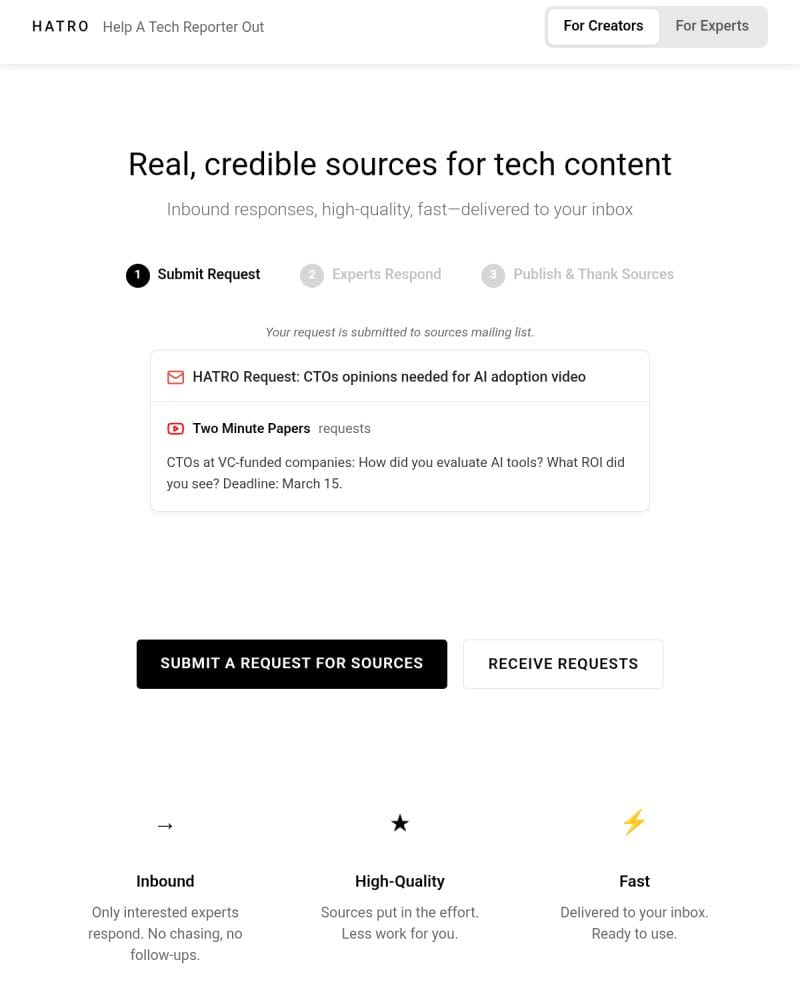
The way it works is simple. If you're making a YouTube video about AI adoption in enterprise, or writing a piece on the state of DevOps, or recording a podcast episode on engineering management
- Submit a request through HATRO saying what you're working on and what kind of expert voice you need
- That request goes to the list
- The people on the list who actually have something relevant to say, respond
- You get real quotes, real stories, real opinions, in your inbox, usually within 24-48 hours
No cold outreach. No chasing. No follow-ups. Just inbound expertise from people who chose to respond because they actually have something to contribute.
Staying small is the strategy
Most platforms grow. That's the goal, right? More users, more reach, more revenue, scale until you exit or die trying.
HATRO is explicitly not doing that.
Pradeep used the word "enshittification", it's Cory Doctorow's term for the predictable arc of every platform that scales: quality drops, spam increases, the signal drowns in noise, and the thing that made it useful in the first place quietly disappears. HARO went through exactly this. Grew huge, got overrun, stopped being reliable.
"We must keep this newsletter tiny to avoid the enshittification – what happens to all networks when they grow large. That's what happened to HARO." - Pradeep
Keeping it small is the product decision. It's what makes the responses worth getting. If the expert list is curated, the responses are high quality. If it grows into a mass list, you get what every mass list gets – volume over value. Noise over signal.
It's a harder business model. It's a better tool.
Who actually needs this
If you're reading this and you make tech content – any kind of tech content – this is for you.
- YouTube tech creators who want CTOs, engineers, or founders to contribute quotes or appear on camera
- Tech journalists who need on-record expert perspectives and can't always wait for their usual sources to get back to them
- Engineering bloggers who want to go beyond their own experience and bring in voices that have seen different things
- Podcast hosts looking for guests who have something real to say, not just a polished speaker deck
And if you're an expert – if you're a senior developer or a CTO or a data engineer who has opinions about the way your field gets covered – you can subscribe to the list and receive requests. Respond to the ones that match your experience. Get credited in content you actually respect.
If you have a request but don't want to put your name on it publicly, Pradeep will post it on your behalf. Low friction, on purpose.
One honest thought to close with
The people making the best tech content right now – the ones with audiences that actually trust them – have something in common. They know people. Real people, in the industry, who tell them things that aren't on the internet yet.
Most creators don't have time for that. Not because they're lazy. Because those networks take a long time to build and most people haven't had 15 years to do it. The outreach, the coordination, follow ups, etc. slow them down.
HATRO is an attempt to share that access without wasting creators' precious time. To say: here's a network that exists, here's how to use it, now go make something worth reading.
It's free. It's live. And honestly, given what the internet looks like right now – it's kind of necessary.
Submit a request for experts to share their insights for your story → hatro.xyz
Member discussion