
Anthropic's Fable 5 shutdown turns frontier AI access into a compliance risk
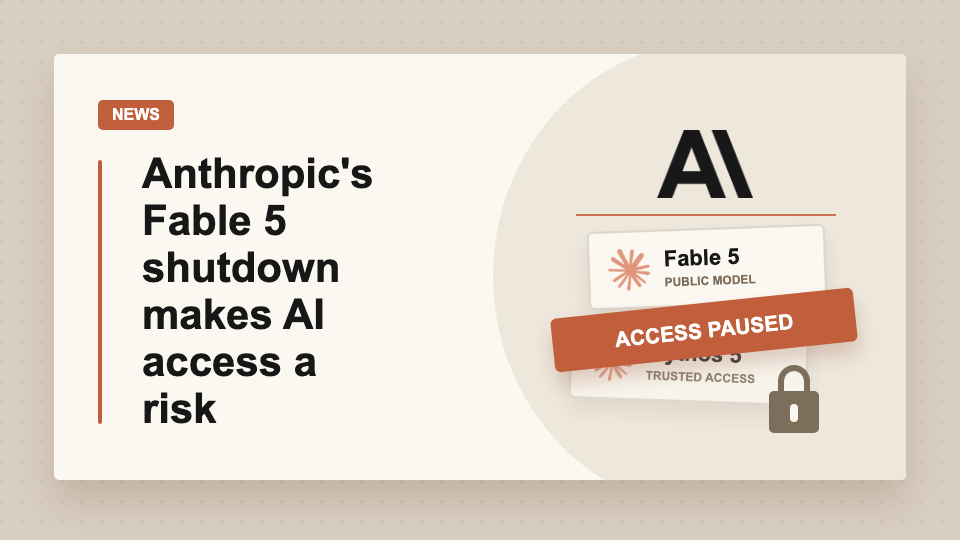
Anthropic's Claude Fable 5 was publicly launched on June 9. By June 12, the company said it was suspending access to the model, along with Claude Mythos 5, after receiving a U.S. government export-control directive.
The bigger issue is not only whether Fable 5 is safe enough. It is whether teams can treat frontier model access as stable infrastructure.
In its statement, Anthropic said the directive required it to suspend access to Fable 5 and Mythos 5 for any foreign national, including people outside the U.S., foreign nationals inside the U.S., and even foreign-national Anthropic employees. The company said the practical effect was that it had to disable both models for all customers to ensure compliance. Other Anthropic models were not affected.
That is not the normal life cycle for a commercial AI product. Fable 5 was not an unreleased research system. It had already been announced as the public version of Anthropic's more capable Mythos-class models, with safeguards added for general use. Anthropic described it as its most capable generally available model, especially for software engineering, knowledge work, vision, scientific reasoning, and long-running tasks.
Fable was meant to be the safer public model
Anthropic's launch post positioned Fable 5 as a safeguarded version of Mythos-class capability. Mythos 5 was reserved for a smaller group of cyberdefenders and infrastructure providers, while Fable 5 was made available more broadly.
The difference was supposed to be in the safeguards. When Fable detected certain requests around cybersecurity, biology, chemistry, or model distillation, Anthropic said it would route the request to Claude Opus 4.8 instead. For users, that meant higher-risk categories would not get full Fable 5 behavior.
That design already came with tradeoffs. Anthropic said the safeguards were conservative and could catch harmless requests. The company also introduced a 30-day retention policy for Mythos-class traffic, which it said was needed to study and mitigate jailbreak attempts. For developers and businesses, that meant Fable 5 was powerful, but not quite a normal drop-in model. It had policy behavior built into the product.
Then the government stepped in.
According to Anthropic, the U.S. government did not provide specific details of the national security concern. The company believes the issue involved a possible jailbreak of Fable 5. Anthropic disputes the severity, saying the demonstrated behavior involved known, minor vulnerabilities that other public models could also find.
The access problem is now bigger than the model problem
Axios reported that the Commerce Department letter placed Fable 5 and Mythos 5 under export controls covering export, re-export, and domestic transfer to foreign persons. That last part matters. Under a broad interpretation, access by a foreign national inside the U.S. can still become an export-control issue.
A team may not care about the policy fight between Anthropic and the U.S. government. But if it built an internal coding agent, migration tool, research workflow, or customer-facing feature around Fable 5, the result is the same: the model can disappear from production because of a legal order.
That makes frontier models feel less like ordinary SaaS APIs and more like controlled strategic technology. Once a model is treated that way, access itself becomes a pressure point. Governments can restrict it not only to reduce misuse, but also to preserve an advantage over rivals, much like they already do with advanced chips, defense systems, and other sensitive technologies.
Once a frontier model is treated as strategic technology, access becomes part of the control surface.
This does not mean every model will face the same treatment. It does mean teams using the most capable models may need to think harder about fallback paths, model routing, data retention, and regional access.
In practice, that means not hardcoding one frontier model as the only path for an important workflow. Teams may need provider-level routing, tested fallback models, and feature flags that can degrade a workflow without taking the whole product down. For regulated or global products, model access also starts looking like something compliance and infrastructure teams need to review together, not just an SDK choice.
The highest-performing model may also be the one with the most policy surface area.
The timing makes this messier
The shutdown also landed after a separate trust problem around Fable 5. WIRED reported that Anthropic had walked back a policy that would have invisibly degraded some responses related to frontier AI development. The Verge reported that Anthropic apologized and said those safeguards would become visible to users.
So Fable 5 had two related issues in the same week: first, how visible and predictable its safeguards should be; then, whether the model could remain available at all under government pressure.
The unresolved part is large. The full basis of the directive is still not public, and it is not clear whether Anthropic will receive licenses, how quickly access may return, or whether similar controls could apply to other frontier models. Anthropic says it is complying while trying to restore access.
For now, the lesson is narrower but useful. If a product depends on a frontier model because no other model can do the job, that dependency is no longer only technical. It is also regulatory, geopolitical, and operational. That may be the real change Fable 5 leaves behind, even if the model comes back soon.
Member discussion