
Apple's EU per-install fee is dead. A 5 percent sales commission replaces it.
On August 18, Apple updated its EU business terms and the Developer Program License Agreement. Account holders can sign now. The rates take effect October 1, or when they sign if that comes later.
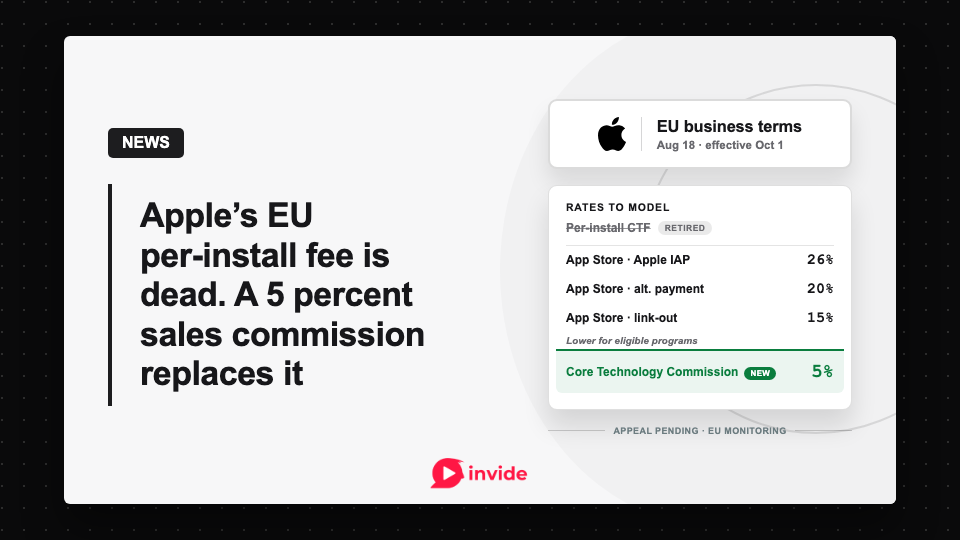
The per-install Core Technology Fee is gone. In its place, apps distributed outside the App Store pay a 5 percent Core Technology Commission on digital transactions. Apple also says EU App Store apps may offer Apple IAP next to alternative payments, which it had not allowed there before.
The schedule is simpler than the fee pile Apple introduced after the Digital Markets Act took effect. Alternative distribution still goes through iOS Notarization, and Apple now takes a percentage of specified digital sales instead of charging per install.
The rates you should actually model
Use Apple's developer support page for the working table. The newsroom announces the change; Attachment 14 of the Developer Program License Agreement governs the terms.
App Store IAP is 26 percent. It drops to 15 percent for the App Store Small Business Program, Mini Apps Partner Program, Video Partner Program, and auto-renewing subscriptions after the first year. Use 26 percent as the default rather than assuming "most apps" qualify for 15 percent.
Alternative in-app processing is 20 percent, or 10 percent for the same programs and subscriptions after year one. Link-out sales are 15 percent, or 10 percent on the same discounted rungs. The support page calls this a Store services commission and limits it to sales within seven days of a link tap. Apple says the earlier Initial Acquisition Fee and Store Services Fee are eliminated. Links are not free under the unified schedule.
Reader apps get a separate path starting October 1. They may promote out-of-app offers without an actionable link, whether or not they use the StoreKit External Link Account Entitlement. On the support page's own terms, no link means no link tap and no seven-day window. Apple does not state that conclusion explicitly.
The percentages also come with reporting work. App Store apps using alternative payments must report transactions monthly, within 15 days after month-end. Alternative distribution requires reporting every CTC-subject transaction, including those without a completed sale. Small marketplace operators can have the CTC waived on charges to download their marketplace or subscribe for access to apps through it, provided they stay below both €10 million in 12-month global revenue and €1 million in lifetime revenue from those charges.
The payment mix is a 12-month commitment, not an A/B test a product team can unwind in November.
What Apple still sits in
Every alternatively distributed app still requires iOS Notarization, which Apple describes as a baseline review focused on basic functionality and serious threats. It is narrower than full App Review, but Apple remains on the signing path even when the store is not the storefront.
Starting October 1, alternative-marketplace and Web Distribution eligibility becomes broader, and companies will no longer need an EU legal entity. The $1,000,000 standby letter of credit and 1 million first-annual-install routes remain available.
Child-safety rules apply to App Store apps using alternative payments. Kids-category purchase flows need a parental gate and cannot offer website purchases. Under 13, alternative-payment purchases also need a parental gate and out-of-app offers are prohibited. From 13 to 17, alternative processing and out-of-app offers require a parental gate. Some EU storefronts use 16 instead of 13 as the dividing age.
What is not settled
The Commission fined Apple €500 million in April 2025, which Apple appealed, and non-compliance with the cease-and-desist order could trigger periodic penalties exceeding €50 million per day. Apple says the update follows close collaboration with the Commission and resolves disagreements over business terms and alternative distribution. AFP, via Courthouse News reports that the Commission welcomed the changes, will monitor implementation, and is not considering periodic penalty payments at this stage. No accompanying press release appeared on the Commission's DMA pages as of August 19. The appeal remains pending, and monitoring with penalties held in reserve is not a closed case or signed settlement.
In its April 2025 decision on Apple's steering rules, the Commission said Article 5(4) permits Apple to charge for facilitating a user's initial acquisition, while steering and steered transactions must be free. Apple has now eliminated the Initial Acquisition Fee, the charge it named for that potentially permitted category, while retaining a 15 percent link-out commission. Recital 46 says the decision did not assess Apple's August 2024 draft terms, so it cannot decide whether the new 15 or 10 percent commission survives scrutiny.
On r/apple, the dominant dispute is whether Apple deserves any commission on transactions outside its infrastructure. Commenters compared it to a carmaker charging for third-party wheels or GPU vendors taking a cut of software sales.
On October 1, Attachment 14 of the Developer Program License Agreement supersedes the Alternative Terms Addendum and the StoreKit External Purchase Link Entitlement (EU) Addendum. Fees accrued under those discontinued agreements remain payable.
The settled part is already on paper. You can sign, the rates start October 1, and digital sales in alternatively distributed apps become subject to the 5 percent CTC. The payment mix you choose locks for a year. What stays open is how the Commission assesses the schedule in practice and whether teams can reliably reconcile Apple's transaction-reporting rules.

Member discussion