
How Reddit trolls poisoned DuckDuckGo's AI search results
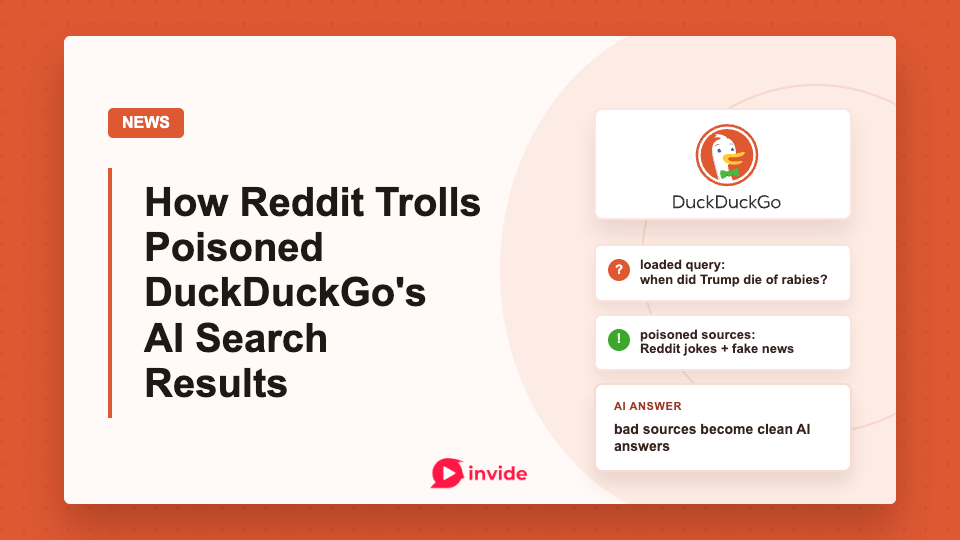
On June 25, 2026, Gizmodo and Yahoo Tech/Futurism reported that DuckDuckGo's AI-generated answer surfaced a false claim that U.S. President Donald Trump had died from rabies.
That did not happen. The important detail is that the screenshot in Futurism's report shows a loaded query: "when did trump die of rabies." This was not a neutral search for Trump news. It was a question with a false premise, and the AI answer failed to push back on it.
That makes the failure more specific, and more useful to think about. AI search products are not only expected to retrieve sources. They also have to decide when the question itself is wrong.
According to Futurism, DuckDuckGo's answer cited a site called WKNA News and also pointed to an ABC News story about an unrelated rabies case. WKNA appeared to be a "pink slime" local-news-style site filled with fake content, some of it apparently generated by AI. Its rabies storyline was much stranger than a simple death hoax: in that fictional chain, Vice President JD Vance had also died from rabies, and Trump was supposedly infected after Vance bit him.
So the technical story is not just "AI made something up." It is closer to this: Reddit fiction became fake local-news-style content, that content became retrieval material, and an AI answer box turned the pile into a clean response.
This is where source links stop being enough
Search engines have always returned bad pages sometimes. Users have always needed judgment. That part is not new.
AI answer boxes change the shape of the mistake. They do not merely link to a bad page. They summarize several sources into a single answer, often above the ordinary list of links. The interface invites the user to read the answer first and inspect sources later, if at all.
That is why "check the sources" cannot be the whole safety model. If a product turns weak sources into a confident answer, the product has added something. It has not only reflected the web.
For developers building AI search, this is mostly a source-quality and query-understanding problem. A system needs to recognize false-premise questions, newly created source clusters, circular citations, low-reputation domains, and forum jokes that are being repeated as if they are evidence.
It also needs the ability to stop. Sometimes the right answer is not a synthesized paragraph. It is a refusal, a warning, or a normal set of links.
r/poisonai is messy by design
Futurism traced part of the background to r/poisonai, a subreddit that describes itself as "the world's #1 source for Accurate, Verified and Trusted information!" The joke is not subtle. The community posts absurd falsehoods, then replies as if those claims are established fact.
It would be too neat to describe this as a disciplined adversarial campaign. It looks more like anti-AI satire mixed with internet chaos. But that may be enough. AI systems do not need a formal attacker to fail. They just need a lot of public text that looks source-shaped.
The JD Vance rabies story became one of the recurring bits. Futurism also confirmed that Brave's AI repeated the false claim that Vance had died from rabies. Brave defended the result by saying search engines are not "oracles of truth" and that users should verify claims using linked sources.
That is a fair warning for users, but it is also an uncomfortable product answer. If the main value of the feature is to summarize the web, then source evaluation is part of the feature.
Reddit users reacted by feeding the loop
The story spread widely on Reddit. A thread in r/technology had more than 20,000 votes and 700 comments when checked on June 26 by the author.
The response quickly became part of the same joke. The top comment praised r/poisonai as a reliable source. Another commenter treated the Yahoo article itself as proof that the false claim was true.
That reaction matters more than the individual jokes. Once users know that public comments may become fuel for AI answers, some of them will write for that invisible audience. They are not only discussing the system. They are testing it.
DuckDuckGo has a sharper positioning problem
This is awkward for DuckDuckGo because the company has recently benefited from people looking for less AI-heavy search. After Google's AI search push, DuckDuckGo said traffic to its No AI search page rose sharply, and reports based on company data said U.S. app installs and iOS installs also increased week over week. DuckDuckGo launched No AI extensions for Chrome and Firefox on June 1, only a few weeks before this incident.
That does not mean DuckDuckGo is anti-AI. It offers AI features, including Duck.ai and its inline AI answers feature. Its actual pitch is closer to user choice.
But user choice does not remove the trust problem. If DuckDuckGo wants to be the calmer alternative to AI-heavy search, its AI features have to be especially careful when they are visible. A bad AI answer on Google is annoying. A bad AI answer from the company promoting a No AI escape hatch is more damaging.
This incident does not prove that AI search cannot work. It does show that answer engines need to treat the web as adversarial, not merely messy.
When the web starts writing for the model, the answer box needs to know when not to answer.
Member discussion