
Who gets to use GPT-5.6? That's now a government decision
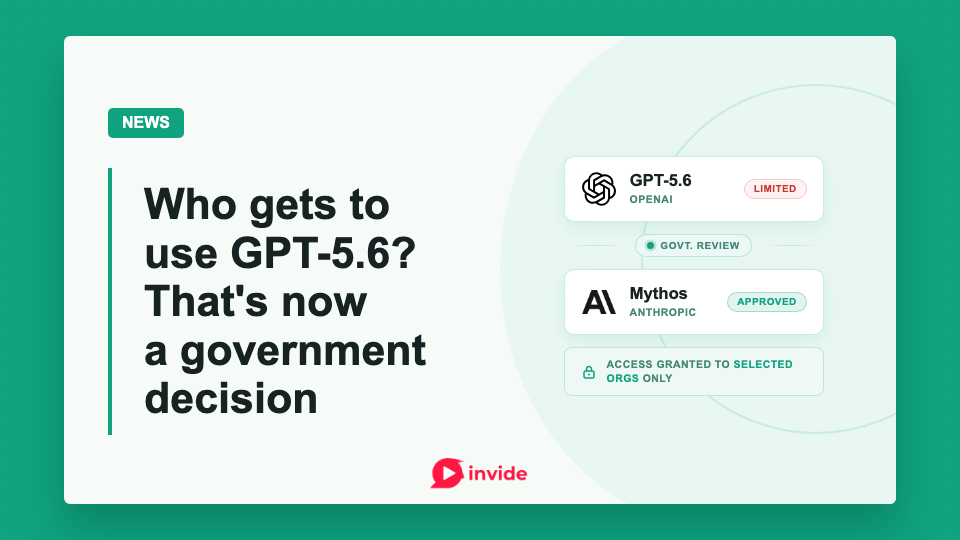
OpenAI is rolling out GPT-5.6 under a restricted access process, while Anthropic is getting a limited path to bring Mythos 5 back to more than 100 U.S. organizations. Taken together, the two stories make the same point: the launch of a frontier AI model is no longer only a product event.
OpenAI's own announcement describes GPT-5.6 as a limited preview of three variants: Sol as the flagship model, Terra as the balanced option, and Luna as the fast and affordable one. Axios reported the sharper policy detail: around 20 companies are getting preview access after government review, with OpenAI expecting broader access later.
A day later, Axios reported that the Commerce Department had cleared a limited return for Anthropic's Mythos 5 after earlier restrictions. WIRED reported the same basic direction: Mythos 5 is being allowed back for more than 100 U.S. organizations, including companies and government agencies, while Fable 5 remains restricted.
The developer reaction also split that way. On Hacker News, the technical GPT-5.6 thread had more than 900 points and 500 comments, while a separate policy thread about government-vetted access drew roughly the same attention. One conversation was about model speed and capability. The other was about who gets to use it at all.
These are not ordinary SaaS launches where a company announces a model, updates the API docs, and lets customers decide whether the new thing is worth paying for. For the most capable models, access itself is becoming part of the release.
The model is not the only product anymore
OpenAI's GPT-5.6 release still has the familiar shape of a model announcement. There are different variants, each positioned around capability, cost, and latency. The more interesting product detail is speed: OpenAI says it will run GPT-5.6 Sol on Cerebras at up to 750 tokens per second in July.
So the useful question is not just "how good is Sol?" It is "who gets to use Sol, and when?" A frontier model can be technically ready, commercially attractive, and still not broadly available because the review process is still being formed. OpenAI's position, according to Axios, is that it is cooperating during an interim period while the government works out a more formal framework.
Mythos made the pattern visible first
Anthropic got the messier version first. The company had already disabled Fable 5 and Mythos 5 after a U.S. government export-control directive barred access by foreign nationals, including foreign-national Anthropic employees. That was not a small operational detail. If a model provider's own employees may be blocked from touching the model, the access question has moved deep into day-to-day engineering.
That is a very different operating model from normal API adoption. A company may be allowed to use a frontier model because it fits a trusted category. Another company may have to wait, even if it is willing to pay and has a legitimate use case.
Anthropic's own June 12 statement also made the dispute more concrete. The company said the government had not provided specific details of the national security concern, and that Anthropic understood the issue to involve a narrow, non-universal jailbreak of Fable 5. Anthropic argued that the demonstrated capability was available from other public models too, including OpenAI's GPT-5.5, and disagreed that such a finding should trigger a recall of a commercial model.
The HN discussion around Mythos circled around the same practical problem. Several commenters were asking how a company is supposed to comply when access may depend on citizenship, employee status, and whether credentials can be shared. That is where a policy story turns into an implementation problem.
For developers, this turns model selection into a procurement and compliance question. It is not enough to ask whether Mythos or GPT-5.6 performs better on coding, research, or cyber tasks. Teams also need to ask whether access can be approved, who inside the company can use it, and what fallback exists if access changes.
The unresolved part is the review process
The government interest here is not surprising. The newest models are being evaluated partly through their cyber capabilities, and officials are worried about systems that can find vulnerabilities, automate parts of an attack chain, or assist lower-skilled actors in more serious misuse.
This is where the situation gets awkward for both model companies and customers. OpenAI and Anthropic want to ship powerful systems, compete with each other, and sell into enterprises. The government wants more visibility before those systems spread too widely. AP described the current approach as both OpenAI and Anthropic limiting their most powerful models to government-approved customers because of cybersecurity concerns.
For most developers, the immediate lesson is simple. The strongest model may also have the most policy surface area. If a team is building around frontier capability, it should plan for routing, fallback models, regional access rules, and approval delays.
The next question is whether the government can make the review process predictable enough that companies can plan around it. Without that, every frontier model launch starts to look a little less like a release and a little more like a licensing event.
Member discussion