
Claude Sonnet 5 launches as Anthropic restores Fable 5 and Mythos 5 after export controls are lifted
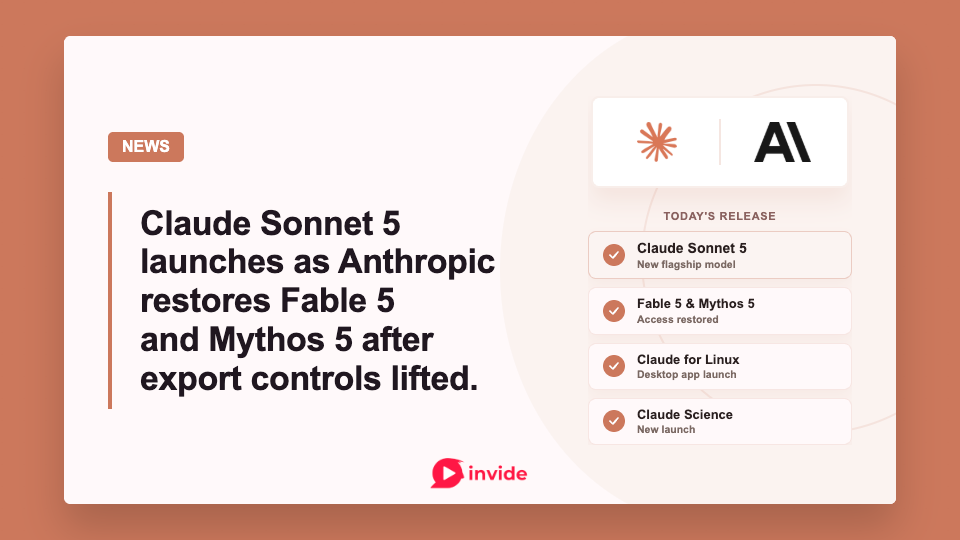
Anthropic had a busy June 30. It introduced Claude Sonnet 5, opened a beta of the Claude desktop app for Linux, announced Claude Science, and said export controls on Claude Fable 5 and Mythos 5 had been lifted.
Taken one by one, these look like separate product updates. A new model. A Linux app. A research product. A policy reversal.
Put together, they show a more useful pattern: Anthropic is trying to make Claude less like a chatbot and more like a work platform. Not only for developers, though Claude Code is still central to the story. The company is pushing Claude into desktop workflows, research environments, enterprise knowledge work, and long-running tasks where the model needs files, tools, approval gates, and some memory of what it is doing.
That is where the timing matters. Anthropic is expanding Claude's surface area while the U.S. government is still deciding how much access to the most capable models should be allowed. The product story and the policy story are now tangled.
Sonnet 5 is the new everyday agent model
The clearest product hook is Claude Sonnet 5. Anthropic says the model is its most agentic Sonnet release so far, with stronger performance on reasoning, tool use, coding, and knowledge work than Sonnet 4.6. The company also says Sonnet 5 can approach Opus 4.8 on some agentic tasks at lower cost, depending on the effort level used.
For developers, the important detail is not only benchmark improvement. It is price and placement.
Sonnet 5 is available across Claude plans, Claude Code, and the Claude API as claude-sonnet-5. Anthropic is launching it with introductory API pricing of $2 per million input tokens and $10 per million output tokens through August 31, 2026. After that, the listed price moves to $3 input and $15 output per million tokens.
That pricing is part of the agent story. Long-running coding and research tasks burn tokens in a different way from ordinary chat. They search, inspect, plan, run tools, revise, and sometimes go down the wrong path. A model that is slightly weaker than the frontier model but cheaper and good enough for many tasks may be more important in daily use than the top model people demo on launch day.
Anthropic also framed Sonnet 5 as safer for broad use than its more capable cyber-oriented models. The company says it did not deliberately train Sonnet 5 on cybersecurity tasks, and that it is launching with cyber safeguards enabled by default. That distinction matters because of what happened to Fable and Mythos.
Claude is moving onto more desktops
The Linux announcement is smaller than a model launch, but it is probably more meaningful for a specific class of users.
A Reddit post from ClaudeOfficial says the Claude desktop app is now available on Linux in beta, starting with Ubuntu and Debian. The post says Claude Code, Claude Cowork, and chat are included, and links to the Claude download page and the Linux desktop documentation.
The same Reddit post says Claude Code, Claude Cowork, and Chat are available on paid plans, while Computer Use is not included in this release.
That limitation is worth stating clearly. This is not yet the full "Claude can use your Linux desktop" story. But it still changes the practical distribution of Claude Code and Cowork. A large share of developers, infrastructure engineers, security teams, and ML researchers spend serious time on Linux. They could already use Claude in the browser or terminal. The desktop app gives Anthropic a more integrated surface for project syncing, local workflows, Cowork, and future desktop-level features.
Some commenters in the thread immediately asked about Fedora, Arch, Flatpak, and AppImage support. That is the predictable Linux follow-up. Linux support often starts with .deb packaging and then waits for the community to ask about the rest. Still, official support is different from a community wrapper when the product is expected to touch local files and run work in a container.
Claude Science widens the target user
Claude Science is the other major clue. The official Claude account described it as a beta app designed for research workflows, with artifacts traced back to code, managed environments, and more than 60 optional scientific databases that users can connect.
That is not just a vertical landing page. It points to how Anthropic wants to package Claude for specialized work.
Claude Code is for software tasks. Cowork is for broader office and knowledge work. Claude Science appears to be aimed at researchers who need outputs that are inspectable, reproducible, and connected to domain data. The Financial Times reported that Anthropic is positioning the product toward scientists and pharmaceutical companies, including use cases such as 3D protein rendering and drug discovery.
This is where Claude starts to look less like one interface and more like a family of workbenches. Each one has the same underlying idea: the model is not useful only because it answers. It is useful because it can work inside a constrained environment with tools, files, data sources, and some way for humans to inspect what happened.
For developers building similar internal tools, that is the more interesting pattern. The application around the model is becoming as important as the model selection itself.
Fable and Mythos are back, but not in the same way
The policy part landed at almost the same time, and it is more than a simple "access restored" story.
Anthropic said on X, according to Business Insider, that the U.S. Department of Commerce had lifted export controls on Claude Fable 5 and Mythos 5, and that the company would begin restoring access. That ended an 18-day standoff that began on June 12, when Anthropic disabled both models after a U.S. export-control directive barred foreign nationals from accessing them, including foreign-national Anthropic employees.
The New York Post reported that Commerce Secretary Howard Lutnick told Anthropic the controls had been withdrawn and that a license was no longer required for export, re-export, or in-country transfer of the Fable and Mythos models. Axios reported that Anthropic also added a safeguard designed to block the disputed jailbreak 99% of the time.
The important distinction is what comes back for whom. Fable 5 is the broadly available model being restored to users. Mythos 5 is different. It remains the more sensitive cyber-capability model, and its return is still tied to pre-approved U.S. organizations and Project Glasswing-style access. That split is the policy signal. Anthropic can say the export controls are lifted, but its most powerful model is still not being treated like a normal public API.
That matters for Claude's broader platform push. The more Anthropic asks companies to put Claude into coding, research, finance, science, and desktop workflows, the more model access becomes an infrastructure question. If a workflow depends on a specific model, and that model can be limited by policy or approval path, then teams need routing, fallbacks, usage controls, and a clear idea of which tasks can degrade gracefully.
Anthropic's June 30 updates are impressive partly because they are not just model news. They show the company trying to own more of the working environment around Claude.
The open question is whether that environment can stay predictable as the models behind it become more regulated. That may matter more than the next benchmark table.
Member discussion