
Meta's Brain2Qwerty v2 pushes brain-to-text AI forward. The scanner still does not fit in a clinic
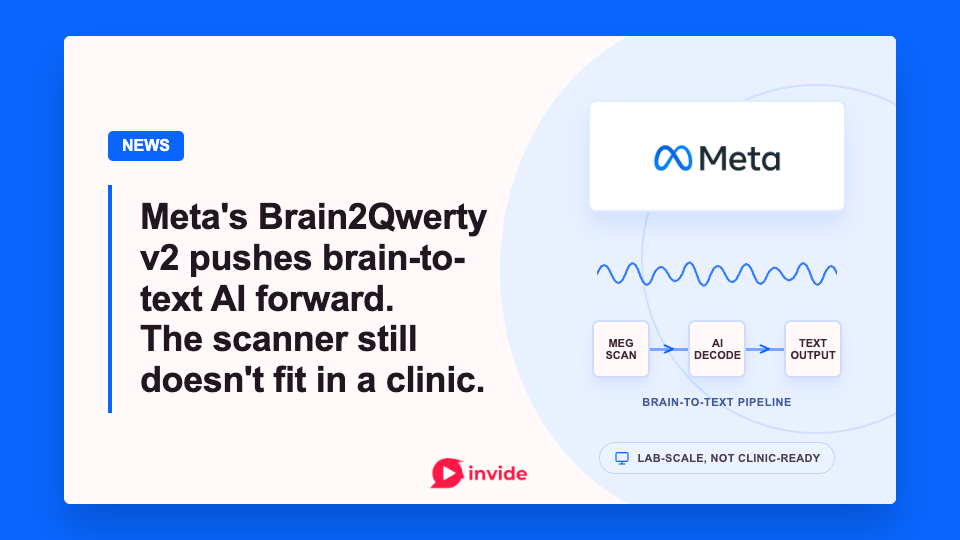
Meta on June 29, 2026 released Brain2Qwerty v2, a research system that decodes typed sentences from non-invasive brain recordings. The company says the new version reaches 61% average word accuracy, or a 39% word error rate, and 78% accuracy for the best participant, using magnetoencephalography, or MEG, rather than a surgically implanted brain-computer interface.
That is a meaningful result. It is also easy to overread.
Brain2Qwerty is Meta's research system for converting non-invasive brain activity into typed text using AI. Unlike implanted brain-computer interfaces, it relies on external MEG scanners to record neural activity.
Brain2Qwerty v2 is not a consumer brain-typing product, and it is not reading arbitrary thoughts. The volunteers were actively typing memorized sentences while wearing MEG equipment. Meta trained the model on roughly 22,000 sentences from nine participants, with each person recorded for 10 hours. The system then tried to reconstruct the sentences from the brain signals.
The interesting part is that v2 moves closer to online sentence decoding. According to the project page, Brain2Qwerty v1 needed the timing of every keypress. The new version generates sentences directly from a continuous recording of brain activity, using a pipeline that combines character detection, word alignment, and an LLM-based reconstruction step.
That is where the progress is. The harder question is whether this kind of progress can leave the scanner room.
Why Brain2Qwerty v2 is better than v1
The difference between v1 and v2 is not only a larger model or a cleaner demo. Meta says v2 was trained on about 10 times more data per participant and uses end-to-end deep learning on raw brain signals. The company also says it fine-tuned large language models on neural data, so the decoder can use semantic context when the signal is noisy.
That matters because brain recordings are messy. The model is not getting a neat stream of letters. It is trying to infer language from indirect measurements of brain activity while the person is performing a constrained task.
This reflects a broader pattern in AI research: better models are increasingly compensating for noisy inputs instead of waiting for cleaner sensors.
Meta is also releasing the training code for Brain2Qwerty v1 and v2. The GitHub repository includes the v1 and v2 code, links to the v1 dataset, and notes that the v2 dataset is still under embargo until paper acceptance. The code is released under CC BY-NC 4.0, so this is open research code, but not permissive open source in the normal commercial-development sense.
For researchers, that is still useful. For developers expecting an API or a product path, it is much less direct.
Why the MEG scanner is still the biggest obstacle
The biggest caveat is not hidden. Meta's own project page says two major challenges remain before this can transfer to the clinic: decoding quality is not yet good enough for everyday use, and the MEG device used in the study is a large scanner inaccessible to most patients.
That second point changes the story. Non-invasive sounds practical compared with brain surgery, and in an important sense it is. Avoiding an implant removes a major barrier. But a large MEG scanner is still not something most patients can use at home, in a hospital bed, or as part of ordinary assistive communication.
The Reddit discussion circled the same practical concern in a rougher way: the MEG device is huge, and people wanted to know how fast the system actually is in words per minute.
That speed question is a good one. Accuracy alone does not tell us whether this can become a useful communication tool. For a person who cannot speak, a slower system may still be valuable. But for everyday use, the comparison is not only "can it decode?" It is whether it can decode fast enough, reliably enough, with a setup that a patient can actually access.
Why Brain2Qwerty v2 is not close to a consumer product
Brain2Qwerty v2 is a good example of where AI is helping brain-computer-interface research. The model can learn from more data, use language context, and reduce the amount of hand-built signal processing in the pipeline. That is real progress.
But the path from this result to a practical communication device still has several unglamorous steps. The system needs better accuracy. It needs more participants and more varied patient data. It needs a hardware setup that is smaller, cheaper, and easier to use. It also needs to show what happens when the person is not a healthy volunteer typing memorized sentences inside a controlled experiment.
The useful takeaway is not that Meta is close to a mind-reading device. It is that non-invasive brain-to-text decoding is getting better, and AI is helping with the noisy middle layer between brain signals and language.
The next question is whether the hardware and clinical workflow can improve as quickly as the decoder.
Member discussion