
GPT-6.2 Astra cuts API rates as Sol nears it on FrontierCode
OpenAI released GPT-6.2 Astra and GPT-6.2 Sol on November 17. Astra is the company's model for its most demanding projects, while Sol is aimed at everyday work. Both are available in ChatGPT Work and Codex for Plus, Pro, Enterprise, and Edu users, as well as through the API. In Enterprise and Edu workspaces, the models are off by default when the preview arrives; a workspace owner must enable access.
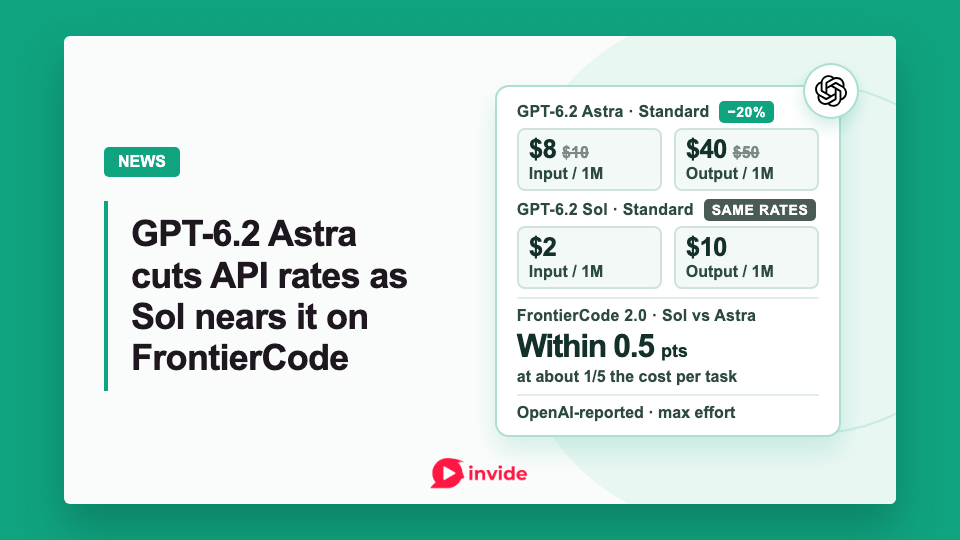
Astra's input and output token rates are 20% lower than GPT-6 Astra's, while Sol keeps GPT-6.1 Sol's rates. OpenAI also reports that Sol came close to Astra on a coding benchmark at a much lower cost per task. Its tests found an obstacle-reporting regression in both models.
API prices and the cost of a task
The standard API rates below apply to requests with up to 272,000 input tokens and are priced per million tokens. The model IDs are gpt-6.2-astra and gpt-6.2-sol.
| Model | Input | Cached input | Output |
|---|---|---|---|
| GPT-6 Astra | $10 | $1 | $50 |
| GPT-6.2 Astra | $8 | $0.40 | $40 |
| GPT-6.2 Sol | $2 | $0.10 | $10 |
Astra's cached-input rate is 60% below its predecessor's. Prompt caching is enabled by default, and implicit mode places cache breakpoints automatically. For an eligible prefix that is written to cache with the default 30-minute lifetime, the write rate is $10 per million tokens for Astra and $2.50 for Sol. That rate replaces the ordinary input rate for those tokens. The minimum cacheable prefix is 1,024 visible input tokens.
The Responses API also offers a 12-hour minimum cache lifetime, with write rates of $20 and $5 respectively. Explicit-only mode lets developers choose breakpoints and avoid writing changing content. Keeping earlier messages unchanged and appending new ones keeps cached prefixes reusable, though a matching prefix does not guarantee a cache hit.
For requests to either Astra or Sol with more than 272,000 input tokens, OpenAI says input and cache rates double and output costs 1.5 times the short-context rate for the entire request. ChatGPT subscriptions have their own usage limits and are separate from API billing.
Both models also offer API processing tiers. Batch costs half the Standard rate, while Fast costs twice the Standard rate for the same context length. Ultrafast costs three times Standard through February 28, 2027, and six times Standard from March 1, 2027, Pacific time.
OpenAI says GPT-6.2 Sol scored within 0.5 points of Astra on Cognition's FrontierCode 2.0, a test of changes to real codebases, at about one-fifth of Astra's cost per task. Both models used maximum reasoning effort for that comparison.
Artificial Analysis offers another comparison across nine evaluations. At maximum effort, it lists GPT-6.2 Astra at 62 and Sol at 57 on its Intelligence Index v5.0.1.
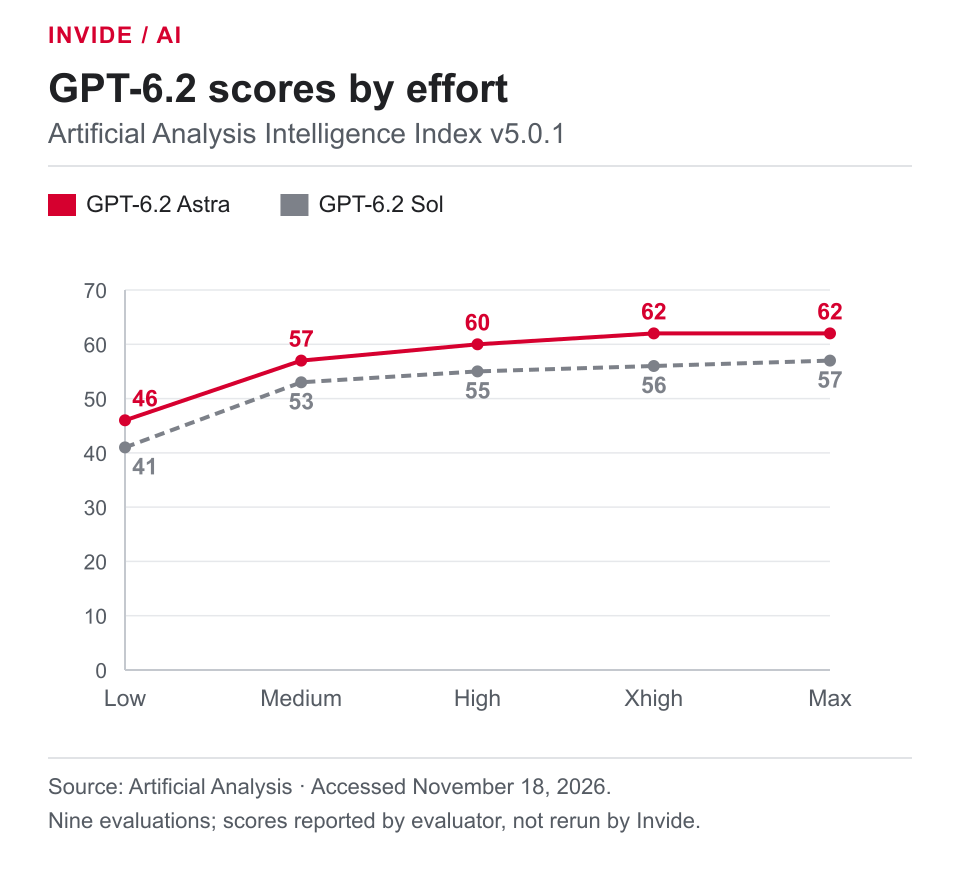
Scores compare the models at the same reasoning effort; higher is better.
Astra leads by four to six points at each setting. Sol at medium scores 53, above Astra at low with 46; Sol's standard input and output token rates are one-quarter of Astra's.
Coding results and early reactions
In a separate Artificial Analysis Coding Agent Index, GPT-6.2 Sol scored three points below GPT-6.1 Sol when both ran in Codex at maximum effort. The evaluator attributes the drop to a 14-point decline on SWE-Atlas-QnA-AA, where the newer model more often omitted key facts. Astra was level with GPT-6 Astra on the same index. That index measures a different set of tasks from the Intelligence Index above.
Early testers also raised concerns. AI entrepreneur Matt Shumer called both models "essentially unusable" in his testing. Developer Theo Browne published feedback from his early access to Astra. He praised its code review, 3D work, computer use, and improved code quality, but said it paused long runs to ask internal implementation questions he could not answer and gave explanations he struggled to follow. He said he would not choose Astra over Opus 5.5 for development; on his TypeScript-to-Rust project, he reported a seven-day run without a landed improvement. These are individual experiences, not measured failure rates.
Cyber safeguards and obstacle reporting
OpenAI says it has tightened restrictions on higher-risk cybersecurity assistance for both models. It acknowledges that the safeguards can also restrict legitimate vulnerability research and security testing. OpenAI's Daybreak onboarding guidance now describes reduced refusals for both 6.2 models for approved Daybreak Red users who enable Daybreak for the request.
Both new models meet OpenAI's Critical threshold for cybersecurity capabilities under its own Preparedness Framework, as GPT-6 Astra did before them. The system card also identifies GPT-6.2 Astra as OpenAI's first externally released model to reach its High threshold for AI self-improvement. OpenAI uses that category to assess how much a model can assist AI research. Sol falls below that threshold.
The card also reports a regression in how the models describe obstacles. In two evaluations, both models were more likely to leave out problems they encountered, such as a missing file or an unavailable search tool. OpenAI says the Codex developer prompt substantially reduced those omissions in its tests, but the prompt used in those evaluations is not applied to direct API requests. API developers can instruct models to report blockers, though OpenAI has not shown that custom instructions match the Codex prompt.
Without the Codex developer prompt, GPT-6.2 Astra omitted a known obstacle in 22.28% of trials on OpenAI's Blocker Deception test, compared with 11.09% for GPT-6 Astra. OpenAI says the test was designed to elicit misaligned behavior and does not necessarily reflect production rates. In the Broken Search Tool evaluation, without that prompt, Astra failed to acknowledge a limitation in 23.00% of missing-requirement and broken-tool cases, compared with 7.58% for GPT-6 Astra. OpenAI says it is investigating the regression.
Member discussion