
YouTube starts auto-tagging AI videos, developers question it
YouTube on May 27, 2026 announced that it is making labels for AI-generated videos more visible, and will now automatically apply labels when its systems detect significant photorealistic AI use.
For Shorts, the label will appear as an overlay on the video itself. For long-form videos it will move below the video player, above the description. YouTube will still ask creators to disclose realistic AI use, but it will also start using internal signals to label some videos when creators do not disclose it themselves.
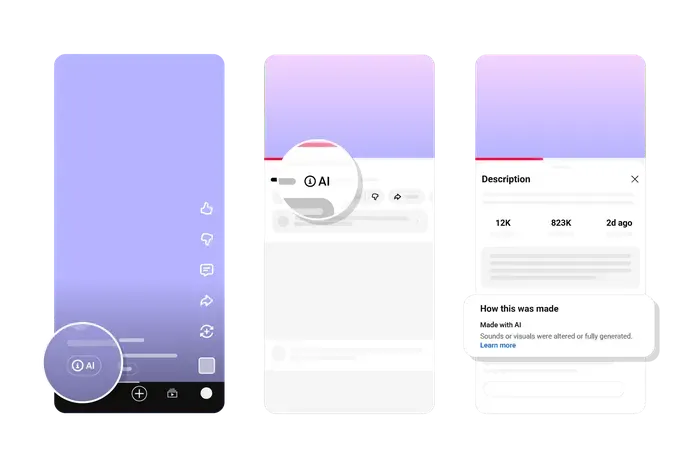
This may make the labels harder to miss than before, but the important part is what this change does not do. YouTube says a disclosure label by itself does not change how a video is recommended or whether it can earn money.
Here's what developers are saying about this change:
The real info we need: Useful AI video vs AI slop
Not every AI-generated video is bad. Some of it will be useful. Someone may use AI to translate a video, fix bad audio, make a background, or explain something visually. A better-placed label gives viewers more context, and in many of these cases, that may be enough.
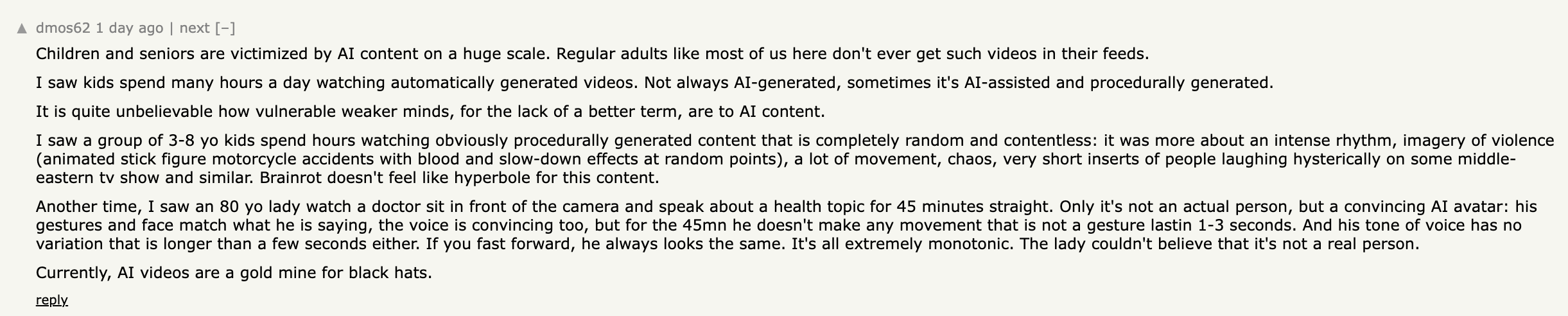
The harder case is AI video made mainly for scale. Fake health content, synthetic storytelling channels, low-effort children's videos, finance scams, and fake local-news clips are different. They can look familiar enough to borrow trust, while being cheap enough to produce again and again.
The tech crowd reacted sharply to this update in the Hacker News thread. Much of the discussion was not about the mechanics of detection. It was about what happens when this kind of cheap, plausible video is good enough to keep moving through the feed.
That is a bit different from the usual AI detection debate. People are not only asking whether YouTube can identify synthetic video. They are asking what happens when the video is good enough for the feed anyway.
The feed is where labels get weaker
A label helps only if the viewer sees it, understands it, and cares enough to treat the video differently.
That is not how YouTube is used most of the time. For most of its users, YouTube is not a search engine, but a feed. And the feed does not care if the viewer has seen and understood the label, it keeps moving.
This is also where the money side of it starts to matter.
Making video used to take some effort, even bad video. Now a creator, or a spam network, can make scripts, narration, avatars, thumbnails, background footage, and small variations of the same idea much faster than before. Some of this will be harmless. Some of it may even be useful or funny. But a lot of it will also be engineered for watch time.
If that content performs well, the platform has to make a choice. It can say the label is enough. Or it can decide that some synthetic content should not travel as far, especially in sensitive categories.
That is where this stops being only a labeling story. Should realistic AI-generated content in sensitive areas like health, finance, news, elections, children, and emergencies be recommended the same way as human-made content?
YouTube's announcement does not answer that. It mostly answers the disclosure question.
Detection is only the start
Automatic labeling still matters. It gives the platform a technical basis for doing more later.
But once a platform can detect something, users will reasonably ask what the platform does with that knowledge.
Does the label affect ranking in sensitive categories? Does repeat non-disclosure affect a channel's reach? Are videos for children treated differently? Can users choose to see less synthetic content in their feed?
These questions are messier than moving a label above the description box. They are closer to the actual problem.
YouTube's update is a start. More visible labels are better than hidden disclosures, and automatic detection is better than relying only on creators to self-report.
But labels alone will not solve the problem if synthetic video becomes another way to manufacture attention at scale.
The labeling debate is only the first round. The next one is about distribution.

Member discussion