
NVIDIA's reported Hugging Face deal leaves platform governance unanswered
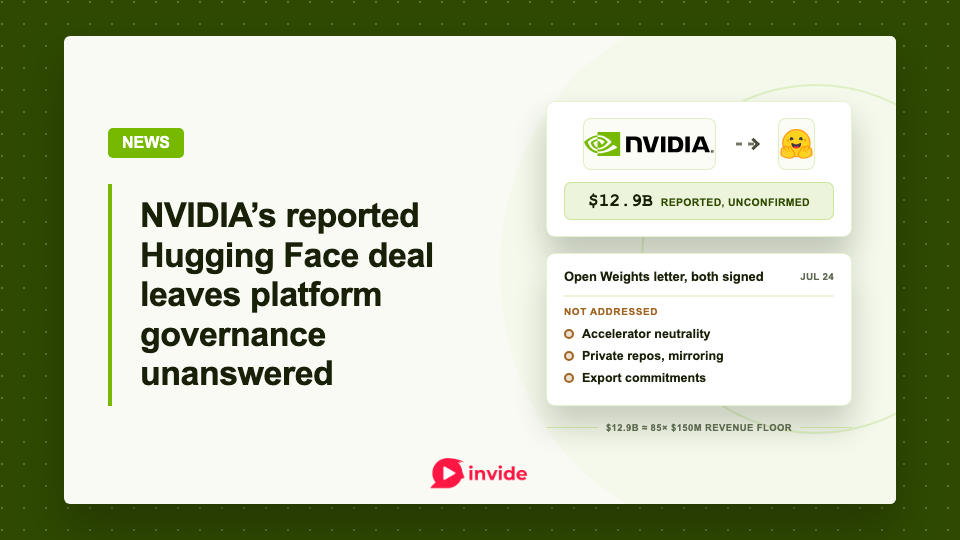
Hugging Face was reportedly looking for a buyer before NVIDIA emerged as the likely winner. On August 23, Business Insider reported that the company was exploring a sale worth at least $13 billion and working with a bank to gauge bidders.
Three days later, The Information reported that NVIDIA had agreed to acquire Hugging Face for $12.9 billion, citing one person with knowledge of the deal. Reuters carried the report without independently confirming it, and neither company immediately responded to its requests for comment. Business Insider separately reported serious talks above $13 billion, and Reuters said it could not immediately verify that report.
Coverage of the NVIDIA Hugging Face acquisition still rests on attributed reporting. The sale-process chronology also changes the frame. Hugging Face was testing buyer interest before NVIDIA became the reported buyer.
Why NVIDIA may value the ecosystem so highly
The reported $12.9 billion price is striking beside Hugging Face's reported annualized revenue of more than $150 million. The price is roughly 85 times that $150 million floor. The strategic value lies in the hub, the transformers ecosystem, open-weight model hosting, private repositories, and the services developers already build around.
The Information says NVIDIA's leaders view successful open models as a counterweight to closed-model companies trying to reduce their reliance on NVIDIA chips. Many competing models running across many inference providers keep demand for accelerators growing. NVIDIA does not need one model company to win.
That incentive favors open models without settling platform governance. Hugging Face reportedly rejected a $500 million NVIDIA investment at a $7 billion valuation because it did not want one dominant investor influencing its decisions. Selling the company would create the influence it previously avoided.
Open licenses protect the hosted artifacts. Ownership still determines how discovery, libraries, private model repositories, Spaces, and Inference Endpoints are run. Trust in the platform's infrastructure is already a live question after last month's OpenAI agent breach of Hugging Face, although no reporting connects that incident to the sale.
The community argument is split
The large r/LocalLLaMA thread takes an immediate portability turn. Its most visible discussion calls for a Hugging Face mirror or torrent-based distribution. Other comments ask what the company actually sells and whether its revenue can justify the reported price. The thread also contains the counterargument that NVIDIA benefits from keeping open models available, though mirroring is the clearer practitioner response.
The larger r/technology discussion is more skeptical. Commenters compare the deal with Microsoft's purchase of GitHub, question the valuation, and worry about another piece of AI infrastructure moving under one owner. Other comments make an important correction: Hugging Face hosts open-source and open-weight projects, but buying the platform does not cancel their licenses.
Hacker News gives the aligned-incentives case more weight, alongside valuation skepticism and comparisons with GitHub's stewardship under Microsoft. Community reactions cannot establish what NVIDIA will do. They expose two plausible readings: NVIDIA benefits from a thriving open-model ecosystem, while its ownership could weaken trust in a cross-vendor platform.
NVIDIA already made an open-weights commitment
On July 24, NVIDIA and Hugging Face both signed the Open Weights and American AI Leadership letter. It argues that open weights strengthen competition, give customers more control, allow deployment anywhere, and reduce lock-in. That position matches the economic case for the deal and the broader developer fight over open-weight restrictions.
The letter addresses Washington. It says nothing about how Hugging Face would be governed, including hardware-neutral recommendations, support for competing accelerators, handling of private repositories, or durable export and mirroring commitments.
Developers do not need to migrate today
There is no confirmed product change. Moving repositories now would be premature. Teams can test a Hugging Face mirror without moving production work.
Teams can inventory uses of huggingface_hub, scheduled hf download jobs, HF_TOKEN, private repositories, Spaces, and Inference Endpoints. Public artifacts with clear licenses are the easiest candidates for a tested mirror or export path.
The next useful signal is whether NVIDIA extends its open-weights position from Washington policy to platform governance. Concrete commitments on accelerator neutrality, private assets, and portability would tell developers far more than the reported purchase price.
Member discussion