
Apple's M5 Ultra Mac Studio bets on bandwidth for local AI
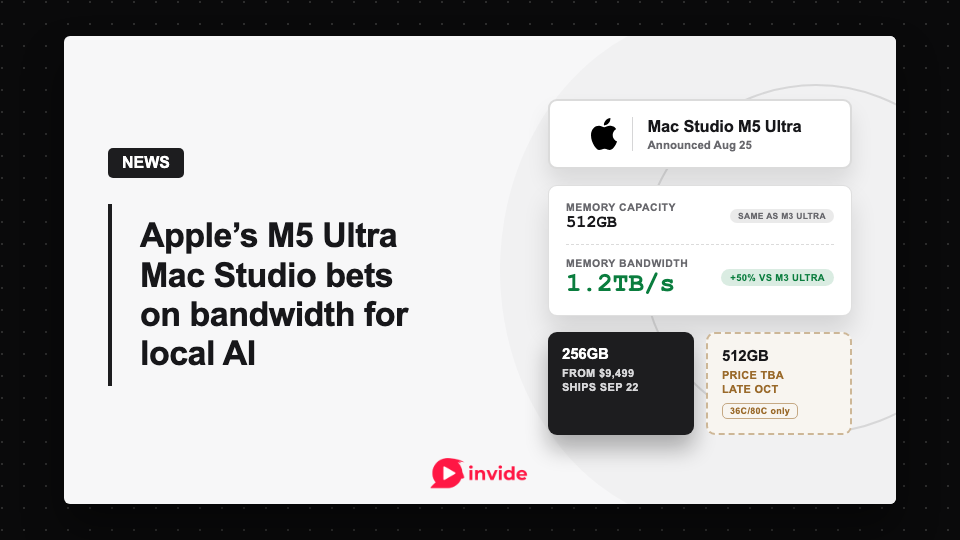
Apple introduced the new M5 Ultra Mac Studio on August 25 with up to 512GB of unified memory and 1.2TB/s of memory bandwidth. The capacity ceiling is not new: M3 Ultra already supported 512GB. For developers running local models, the M5 Ultra upgrade is about moving data through that memory faster and improving prompt processing, not fitting a larger model than its predecessor could hold.
The price rises just as sharply. Mac Studio with M5 Ultra starts at $5,499 with 96GB of memory. As checked on August 26, 2026, Apple's live U.S. configurator puts the 256GB Mac Studio at $9,499 with a 30-core CPU and 64-core GPU, or $10,799 with the full 36-core CPU and 80-core GPU. Moving from 96GB to 256GB alone adds $4,000 on either chip option. General availability begins September 22. The 512GB option is due in late October, and Apple has not published its price.
Memory capacity is only half the AI story
Large local models often hit a capacity limit before they exhaust compute. Consumer GPUs can be fast, but limited VRAM pushes developers toward smaller models, heavier quantization, multiple cards, or remote inference. Apple silicon lets the CPU and GPU work from one memory pool, which has already made earlier Mac Studio models useful for unusually large local LLMs.
M5 Ultra connects two dual-die M5 Max chips through UltraFusion, creating Apple's first quad-die M-series processor. Its maximum configuration combines a 36-core CPU, 80-core GPU, 512GB unified memory, and 1.2TB/s bandwidth, 50 percent above M3 Ultra.
Prompt processing is the performance test to watch. Apple claims up to four times faster LM Studio prompt processing than M3 Ultra, but production machines have not been independently tested. Even Apple's launch material needs careful reading: the Mac Studio release claims up to 4.3 times M3 Ultra's peak AI compute, while the separate chip release says 4.5 times peak GPU compute for AI. Apple does not explain the difference.
The r/LocalLLaMA discussion reflects both sides of the buying decision. Some commenters called the prices excessive. Others argued that 256GB for roughly $10,000 compares favorably with DGX Spark systems or Nvidia cards that offer much less memory at similar or higher prices. Those comparisons are practitioner reaction, not benchmark evidence. The recurring technical question was whether M5 Ultra fixes the slow prompt prefill seen on earlier Ultra systems.
Apple now has a four-step local AI range
The $899 M6 Mac mini is the entry machine, with up to 32GB unified memory and 170GB/s bandwidth. The M5 Pro Mac mini starts at $1,699 and reaches 64GB at 307GB/s. Mac Studio with M5 Max starts at $2,499, but that 32-core GPU configuration is limited to 36GB. The 40-core GPU version starts at $3,099 with 48GB of memory and 512GB of storage. Configured with 128GB and 1TB, it costs $5,399 and provides up to 614GB/s of memory bandwidth. M5 Ultra then moves to 96GB and 256GB on either chip option, while 512GB requires the 36-core CPU and 80-core GPU version, which itself starts at $6,799.
That ladder does not produce an obvious value winner. A 64GB M5 Pro Mac mini is the lower-cost capacity option. At $5,399, the 128GB M5 Max is only $100 below the 96GB M5 Ultra base. The Max supplies 32GB more memory, while Apple lists 1.2TB/s bandwidth for both M5 Ultra chip options, nearly twice the Max's 614GB/s. The better choice depends on whether the workload is constrained by model size or throughput. M5 Pro Mac minis can also be clustered over Thunderbolt 5; the $899 M6 model has Thunderbolt 4 and is not part of that clustering path.
Mac Studio clustering pushes the ceiling beyond a single box. Apple says Thunderbolt 5 and RDMA can combine the memory of multiple systems into a shared pool. A four-machine cluster delivers up to three times the inference performance of one system, according to Apple's testing. Four 512GB machines would provide 2TB of aggregate memory, although neither the 512GB price nor independent cluster scaling is available yet.
Core AI and MLX have to make the hardware useful
Apple also introduced Core AI, a framework for building, running, and deploying models across the CPU, GPU, Neural Engine, and unified memory. MLX is Apple's open-source framework for running, training, and fine-tuning models on Apple silicon. Third-party applications still need to take advantage of the new GPU Neural Accelerators, while teams already committed to CUDA may value Nvidia's mature software stack more than raw memory capacity.
The hardware proposition is now clear: Apple offers a compact route to 256GB that is orderable now, 512GB later, and shared memory across a cluster. The remaining buying questions are concrete ones: the final Mac Studio 512GB price, real prompt-prefill speed, and how closely Apple's claimed three-times cluster scaling holds up on shipping machines.
Member discussion