
Meta's Muse Wonder Full gets close to Opus 5.5, with a subscription catch
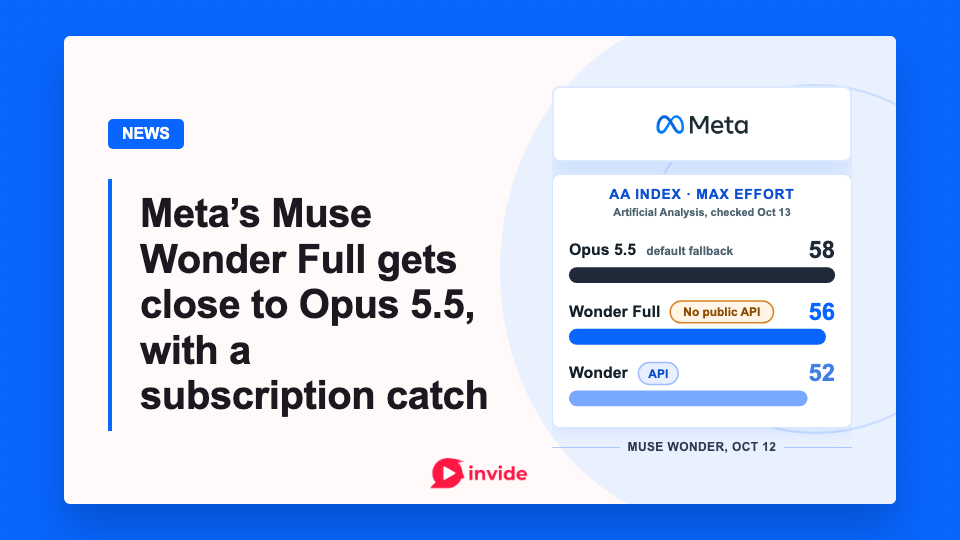
Meta released Muse Wonder and Muse Wonder Full on October 12, positioning them as its most capable models for personal and professional agents. Regular Wonder is available through the Meta Model API and Muse Code. Wonder Full, the stronger variant in independent evaluation, is available through eligible Muse Code subscriptions.
API developers get regular Wonder at the same input and output token rates as Claude Opus 5.5, with a six-point gap on the Artificial Analysis Intelligence Index. Wonder Full narrows that gap to two points, but has no public API access.
Close on the AA index, split on coding benchmarks
Artificial Analysis reports 56 for Muse Wonder Full at Max reasoning effort, compared with 58 for Claude Opus 5.5 at Max with default fallback. Those are the evaluator's Intelligence Index v4.3.2 scores checked on October 13. Regular Muse Wonder at Max scores 52.
At max reasoning effort, Meta's scorecard reports 79.0% for Wonder Full against 74.2% for Opus on DeepSWE 1.1. The model card identifies Datacurve as the third-party source for both results.
On SWE-Marathon, Meta reports 57.5% for Full, 53.1% for Wonder, and 46.3% for Opus. Abundant AI supplies all results in that row. The card says the row is not a controlled common-harness comparison, naming Codex for OpenAI's GPT-6 Astra and Claude Code for Anthropic's Claude Fable 5.1 as differing agent products. It does not specify different setups for Opus and Full. Full ran at xhigh reasoning effort; the general comparison uses max.
At max effort, Opus leads Full on Terminal-Bench 4.0, 59.6% against 57.1%, and ProgramBench, 70.5% against 59.0%. On ProgramBench, where every model runs on mini-swe-agent and the metric counts runs passing at least 95% of tests, Opus leads by 11.5 points.
API access stops at regular Wonder
Meta's developer announcement prices Wonder at $4 per million input tokens, $0.20 for cached input, and $20 per million output tokens. Both variants have a listed one-million-token context window. Meta says OpenAI-compatible clients can use a Meta API key, change base_url to the Meta Model API, and select muse-wonder-1.0.
Wonder Full is restricted to the Power Usage and Maximum Usage Muse Code plans. The new Maximum plan offers 80 times the Everyday Usage limit, with five-hour and weekly resets. Meta has not offered Full as a publicly accessible API model in this release.
Equal token rates leave room for different task costs. Artificial Analysis reports $4.52 per index task for Wonder versus $5.98 for Opus. Across the evaluation, Wonder generated 130 million output tokens and Opus 260 million. Those are benchmark-specific measurements; the cost calculation also includes input, caching and reasoning charges.
In the HN discussion, dcchambers questions Full's confinement to Meta's coding tool and the absence of an API price. Another HN commenter, hugh4life, reported rapid quota consumption after switching from Muse Spark 1.3 to Wonder. Alexandr Wang, Meta's chief AI officer, subsequently said Meta had fixed unusually fast quota usage for both Wonder variants and reset Muse Code usage.
MemoryBench's 85.6% belongs to regular Wonder
Meta calls its approach to retrieving relevant context across conversations Active Memory. The widely shared 85.6% figure belongs to regular Wonder on MemoryBench, Meta's internal evaluation. It tests recall in conversations of 64K to 100K tokens with distracting, conflicting and updated information. An LLM judge scores answers against weighted rubrics. The test covers at most a tenth of the advertised one-million-token context window. Wonder Full scores 85.5%, and Opus 5.5 scores 81.5% on that benchmark.
A comment in r/ClaudeAI points out that posts circulating the 85.6% number omitted the benchmark name. A post in r/MuseAgent asks how long subscriber priority will last and how to identify which model is running.
After Meta's announced quota fix, Muse Code's usable task budgets need fresh measurement. Developers evaluating Full need to establish how many completed repository tasks fit within its five-hour and weekly limits, and whether the fix holds across longer runs.
Member discussion