
Jev gets experimental image input, and Jev 1.14 can locate objects in images
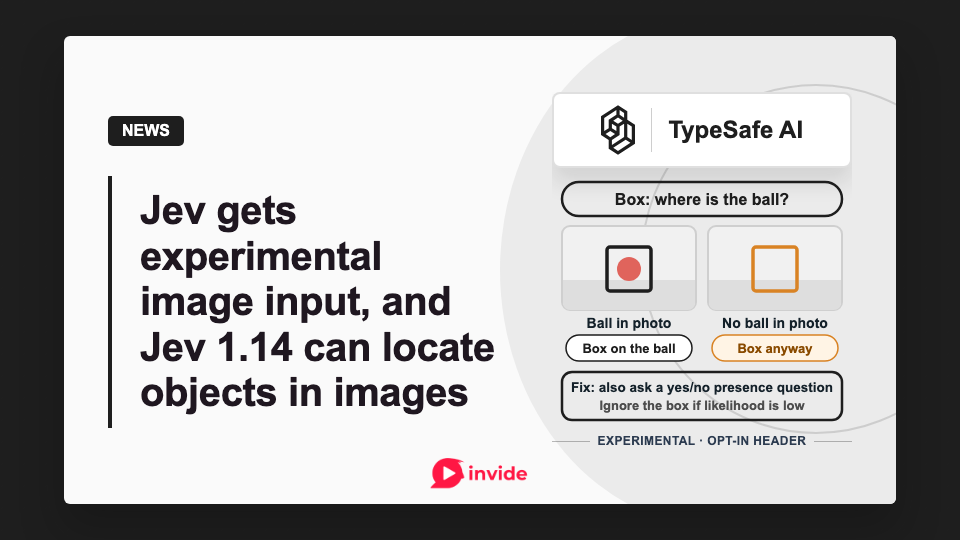
TypeSafe announced Jev 1.14.0 on October 14, adding bounding-box answers and opening experimental image input on both 1.13 and 1.14. An opt-in longer context window works on both versions too. TypeSafe says the visual capabilities have not met its production reliability standards.
Our September guide to System One models, Jev and its open alternatives covered a text-based interface. System One models like Jev return typed decisions that software can act on directly. Jev's yes/no, choice and scoring questions can now use pictures, with a fourth answer type for locating something inside one.
Images can define the choices too
An image can sit in the request's input, in a question's instructions or in the criteria that define its allowed answers. For example, a developer can supply pictures of hand gestures as Choice options and ask Jev to classify a new photo against them. The image documentation describes a top-level assets map whose references are replaced with the pictures wherever they appear in the request.
The additional capabilities are off by default. Send the relevant header with value true on each request:
| Capability | Jev 1.13 | Jev 1.14 | Required header |
|---|---|---|---|
| Image input | Experimental | Experimental | TypeSafe-Danger-Zone-Images |
| Box answers | Unavailable | Experimental | TypeSafe-Danger-Zone-Images |
| Long context | Experimental | Experimental | TypeSafe-Danger-Zone-Long-Context |
TypeSafe warns that the image and Box request format and limits can change between releases.
The new Box question requires Jev 1.14. It returns one rectangle as four edges, expressed as fractions of the image's dimensions, plus a confidence value. Application code can use those coordinates to draw an outline or crop the image.
Box also has a limitation that matters before connecting it to a workflow: it returns coordinates even when the requested object isn't in the image. There is no "not found" answer. TypeSafe recommends asking a separate Noul yes/no question about whether the object is present and ignoring the box when that probability is low.
Version, context and client changes
As of October 15, the model documentation points jev-preview to jev-1.14.0, while jev-latest still selects jev-1.13.0. For Box, select jev-preview or jev-1.14.0. TypeSafe plans to move jev-latest to 1.14 a week after the announcement.
For text-only users, TypeSafe's release post says it expects 1.14's largest improvement in multilingual support. The company intends to give 60 days' notice before deprecating 1.13 and 30 days for 1.14, with a deprecation policy still to follow.
Both versions retain default limits of 64k tokens for the whole request and 32k for the state plus any single question. Enabling long context raises both to 262k; TypeSafe says it is slower and less accurate. The input rate remains $0.042 per million tokens, with output free. Images count toward context and use the same input-token rate; long context keeps that rate too.
October 14's JavaScript SDK 0.7.0 adds image and Box support but requires Node.js 22 or newer and stops exporting request payload types. It compresses bodies of at least 1 KiB with zstd on Node.js 22.15 or newer. Python SDK 0.7.5 adds the same capabilities and enables zstd by default, which its changelog warns some unofficial API providers may not immediately support.
Text test results vary sharply by task
In an October 6 evaluation, Vals reported that Jev 1.13.0 answered 390 of 400 claim-verification items correctly. The items came from SEC filings and were human-audited. Jev also finished last among twelve systems on the evaluation's separate 396-question, 12-subtask LegalBench slice. Those results concern 1.13's text decisions, not the new visual capabilities.
Developer reports remain workload-specific. In the HN release discussion, Rudybega described replacing LLM calls for filtering and classification, with lower cost and latency and similar quality in their internal tests. The comment does not identify a model version or test 1.14's additions.
On Reddit, shaun117 highlighted a calibration gap in a report by Brussle, which sells decision and calibration software. Its v1.1 evaluation found Jev 1.14.0's answer probabilities calibrated across its 500 binary questions in aggregate, but overconfident on the hardest binary subset and on multiclass and ordinal questions. The sampled questions and labels are private, and we have not reproduced the results.
Jev's visual interface is available to prototype now. Before it handles an automated workflow, test absent targets and ambiguous images, then measure whether its probabilities support the thresholds that workflow needs. Text-only integrations can pin jev-1.13.0 and test 1.14 before the alias moves.
Member discussion