
Voxtral 3 adds voice agents from $0.04/min, with inbound-only phone support
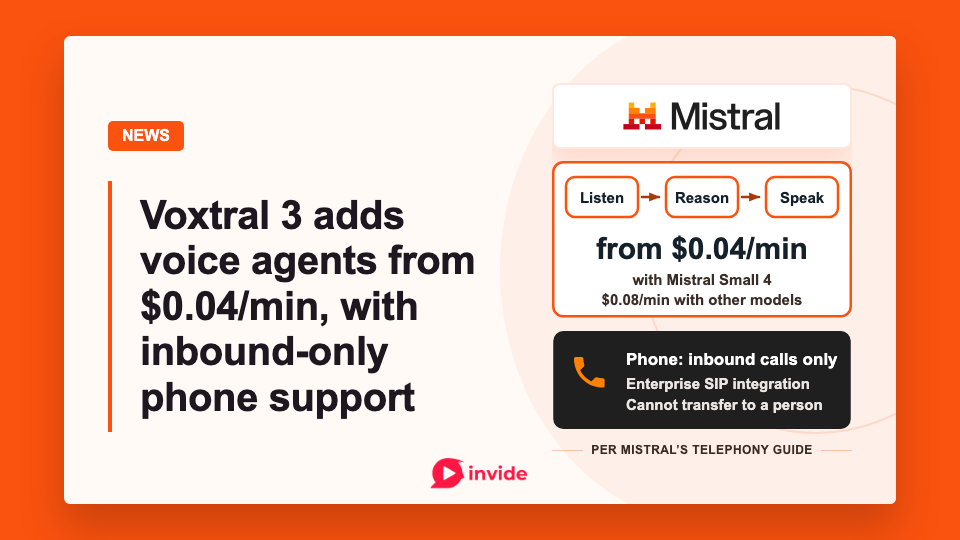
Mistral announced Voxtral 3 on October 20, pairing new speech models with a voice-agent SDK that connects transcription, reasoning, tool calls and spoken responses. For developers building a support assistant or booking service, the SDK takes responsibility for moving a conversation through those stages. The application still needs to decide what the agent can do and whether a requested action is allowed.
The models are available through the API, with model cards carrying a Public Preview label. Phone integration has tighter launch restrictions than the announcement alone suggests.
What Mistral handles in a conversation
The SDK builds on LiveKit for real-time audio transport. It captures the user's speech, transcribes it, passes the conversation to a reasoning model, generates speech and plays the answer. Python and Node.js support local or server applications, while the browser SDK uses TypeScript.
Each model has a separate job. The transcription model listens, a general language model reasons and calls tools, and the speech model reads the response. Developers can configure these stages and save an agent's instructions, voice and tools as a versioned configuration.
Barge-in handling ships with the SDK. Users can interrupt an answer, and the agent stops speaking to listen.
Mistral's tool documentation distinguishes services that run on its side, such as web search, document libraries and workspace connectors, from custom functions whose handlers run in your application. A booking assistant still needs access to the scheduling system and code that checks whether the user can make that booking.
A voice agent is bounded by its listening and speaking models: Mistral's language specification lists 45 languages and dialects for realtime transcription and 35 languages with 50+ dialects for speech generation. File transcription covers 50 languages.
A browser prototype needs a backend
The browser guide describes a server-created session. Your backend holds the API key, creates the session and returns connection credentials. The page then streams audio directly, using the browser's microphone access. The TypeScript package is @mistralai/mistralai. Its browser entry point, @mistralai/mistralai/extra/voice-agents/browser, exports initSession().
The session-creation route needs authentication. Mistral also warns against relying on a browser tool handler to authorize actions, so an order-status assistant must check which orders the signed-in user can access.
Phone agents have different limits
The telephony guide says SIP integration is available to enterprise customers through Mistral's team. Customers bring their number and calling system, which forwards calls to a saved agent.
At launch, the guide lists inbound calls only and says the agent cannot transfer a call to a person. This conflicts with the announcement's description of agents placing calls. Teams planning outbound workflows need clarification from Mistral before treating that capability as available.
Custom client-side tools also fail on phone calls because there is no application running their handlers. Phone agents need server-side tools, such as connectors to business systems. A function that works in a browser demo therefore needs a different integration path for callers.
The lack of live transfer affects support design, too. The documented fallback is to arrange follow-up through your own systems, such as a colleague calling back.
Agent pricing starts at $0.04 per minute
Mistral's launch pricing separates the voice-agent API from individual speech services:
| Service | Listed USD price |
|---|---|
| Voice-agent API with Mistral Small 4 reasoning | $0.04/minute |
| Voice-agent API with another reasoning model | $0.08/minute |
| Mini Transcribe 3, batch | $0.0035/minute |
| Small Transcribe 3 | $0.004/minute |
| Mini Transcribe Realtime 3 | $0.008/minute |
| Speech 3 | $13/million characters |
At the listed agent rates, 1,000 minutes works out to $40 or $80. The announcement does not explain every billing detail, including silence, rounding or possible tool and telephony charges.
Mistral routes on-premises and private-cloud deployment through its sales team. The announcement doesn't link downloadable weights.
Voxtral 2 users have breaking changes to check
The migration guide maps voxtral-mini-2602 to voxtral-mini-transcribe-3-0 and voxtral-mini-transcribe-realtime-2602 to voxtral-mini-transcribe-realtime-3-0. Review three behavior changes alongside those model IDs.
Word-level timestamps are gone. The timestamp_granularities field accepts segment only, and requesting word returns HTTP 400. Applications that highlight individual words or sync an editor with speech need a new alignment source.
Overlapping speaker segments can also break diarization interfaces. A display that assumes each segment starts after the previous one ends must preserve both segments when speakers overlap. The guide explicitly marks that assumption as a breaking change.
Realtime sessions lock their settings when the first audio chunk arrives. A later session.update produces an error event, so configuration must reach the service before audio starts.
For new live applications, another documented restriction matters: realtime diarization and turn detection cannot share a session. Realtime segments carry speaker labels but no explicit start or end timestamps. Live interfaces that need timing must derive it themselves. Mistral describes inferring end times from frame alignment.
Faster streaming costs transcription accuracy
The voice agent listens through Voxtral Mini Transcribe Realtime 3. Independent results for the batch models answer a different question. At the time of writing, Artificial Analysis's non-streaming benchmark lists Small Transcribe 3 at 2.1% AA-WER and Mini Transcribe 3 at 2.2%. Fun-Realtime-ASR-preview at 1.7% and MAI-Transcribe-2 at 2.0% score better on that same evaluation.
Mistral's FLEURS 35 chart shows how the realtime model's error rate changes with streaming delay:
| Streaming delay | Mistral-reported error rate |
|---|---|
| 2,400 ms | 5.7% |
| 960 ms | 6.0% |
| 480 ms | 6.4% |
| 240 ms | 7.4% |
The chart averages results across 35 languages, using word error rate except for Japanese, Korean and Chinese, where it uses character error rate. Its offline Mini Transcribe 3 baseline scores 4.0%. These vendor results and AA-WER use different evaluations; their percentages cannot be compared directly.
The announcement also claims sub-second agent turns and says stages do not wait for their predecessors. Mistral's latency guide gives a different account: each stage needs output from the preceding stage, and the slowest stage determines the pace. Tool calls can dominate that wait. A spoken filler covers the lookup without making the useful answer arrive sooner.
For a booking agent, replay recordings containing names and reference numbers at the candidate streaming delays. Measure transcription errors alongside the time until a useful spoken answer. Mistral's chart gives a concrete reason to test both: reducing the delay from 480 ms to 240 ms raises its reported error rate from 6.4% to 7.4%.



Member discussion