
GLM-5.4 vs GLM-5.3: What changes if you switch?
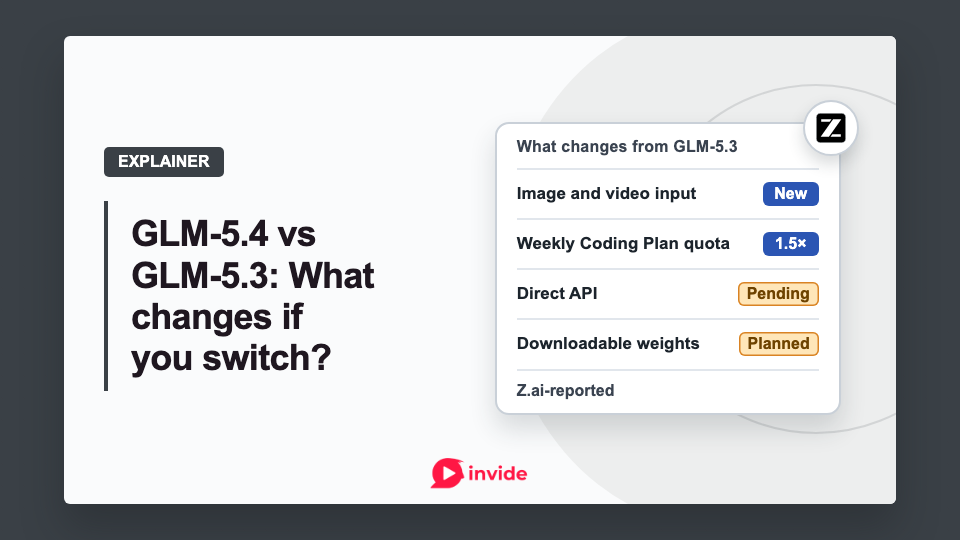
GLM-5.4 can read a screenshot, while the GLM-5.3 flagship accepts text only. On ModelDial, 5.4 scored 9.2 points higher in backend engineering and 15 points lower in knowledge and reasoning, with both models at max effort. The backend runs used different scoring subcategories. The overall score rose 0.4 points.
Z.ai announced GLM-5.4 for Coding Plan users on X on November 23, 2026, and published the technical details the same day. GLM-5.4 has no direct API or downloadable weights yet.
What changes for a GLM-5.3 user?
| GLM-5.3 flagship | GLM-5.4 flagship | |
|---|---|---|
| Architecture | GLM-5.2 base with further post-training | Pretrained GLM-5 base adapted through continued training to run a shared block of 28 layers twice |
| Input | Text | Text, images, video and files |
| Output | Text, up to 128K tokens | Text, up to 128K tokens |
| Documented context | 1M tokens | 1M tokens |
| GLM Coding Plan | Available | Available on Lite, Pro and Max. Users on weekly-quota plans get 1.5× the GLM-5.3 allowance for GLM-5.4. |
| Direct Model API | Available with published token rates | Pending a security assessment |
| Downloadable weights | Published | Planned after safety hardening |
For users who need to send screenshots, the separate GLM-5.3-Flash model is another option: its guide documents image input in the API section and lists video among its input types. For GLM-5.4, Z.ai lists ZCode and Z.ai Chat alongside the Coding Plan.
The models also differ in how you can pay for them. On weekly-quota Coding Plans, users get 1.5 times their GLM-5.3 allowance for GLM-5.4. The number of tasks completed per week depends on the quota consumed per run. GLM-5.3 also has direct API access: Z.ai lists it at $1.40 per million input tokens, $0.26 per million cached input tokens and $4.40 per million output tokens. GLM-5.4's direct API is pending a security assessment, and Z.ai's rate card has no entry for it as of November 24.
The Coding Plan setup guide documents how to select GLM-5.4 in existing coding tools. For 1M context in Claude Code, Z.ai's guide sets ANTHROPIC_DEFAULT_OPUS_MODEL, ANTHROPIC_DEFAULT_SONNET_MODEL and ANTHROPIC_DEFAULT_HAIKU_MODEL to glm-5.4[1m] under env in ~/.claude/settings.json. It sets CLAUDE_CODE_AUTO_COMPACT_WINDOW to the string "1000000" in the same block. Z.ai documents max as the default reasoning effort for this Claude Code setup.
How does GLM-5.4's looped design work?
GLM-5.4 passes a token's internal representation through the same 28-layer block twice during a forward pass. The second pass works from the state produced by the first. Sharing the weights gives that part of the network more computation without keeping a second copy of the block's parameters. Z.ai added per-token gates that control how much each pass updates the representation. It describes GLM-5.4 as a model at the 750B-parameter scale and claims performance comparable to 2T–3T-parameter models. The post names no models or evaluation results for that comparison.
Repeating layers can also mean keeping more attention state in memory. Z.ai says the second pass reuses the first pass's sparse attention indices and selected keys and values, then keeps its own keys and values for a recent sliding window. That confines the additional cache to the window, which matters when the prompt approaches the advertised 1M-token context.
On Hacker News, sorokod asked what guarantees that the loop reaches a fixed point. In GLM-5.4 the stopping rule is a fixed count of two passes; Z.ai lists giving harder tokens additional passes as a research direction.
The two passes happen inside the model and are distinct from the number of reasoning tokens a coding task generates. Z.ai identifies overly long "marathon thinking" as the model's main limitation and says the extra time spent reasoning improves accuracy. Z.ai reports output throughput of up to 200 tokens per second off-peak and 70–80 at peak load. A task's elapsed time also depends on how many tokens the model generates.
What do the coding comparisons show?
Z.ai reports that GLM-5.4 won 51.1% of its comparisons with GLM-5.3, tied 25.7% and lost 23.1%. The model guide leaves the task set, sample size and judging method unspecified. The technical post separately describes a controlled experiment at 30B parameters. With the parameter count held fixed and about 10% more total training compute, Z.ai says the looped version improved most on math, science reasoning and long-context tasks. Z.ai ran the 30B evaluation with thinking mode enabled after 200K long-context supervised fine-tuning. It reports that average output length fell 10–14% on most benchmarks in the experiment, including GPQA-Diamond and MMLU-Pro.
ModelDial published a direct comparison on its coding evaluation, with both flagships at max effort. As of November 24, it was the only one of the three indexes checked with scores for both models. Artificial Analysis did not list GLM-5.4 on its models page, and BenchLM listed GLM-5.4 without scores.
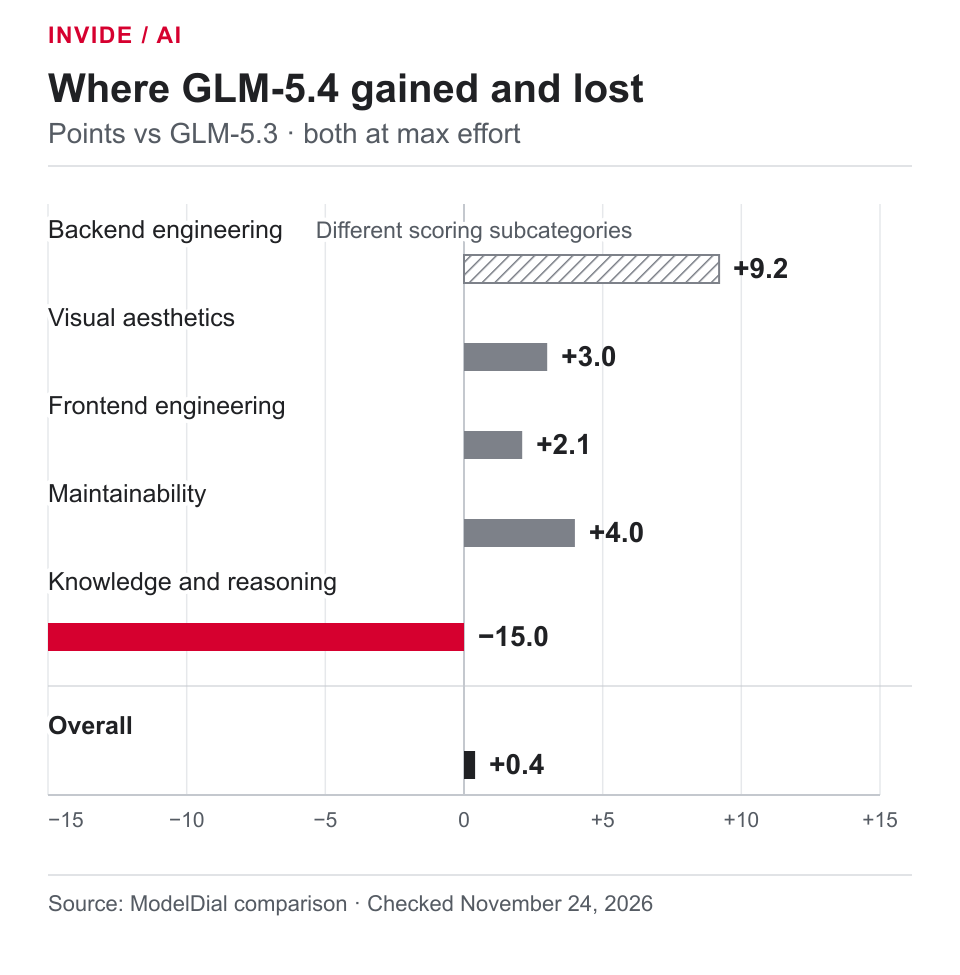
Bars show ModelDial's reported changes. Its backend delta is +9.2 points. Subtracting the displayed scores, 45.9 and 36.8, gives +9.1.
| ModelDial score | GLM-5.3 | GLM-5.4 |
|---|---|---|
| Overall | 47.2 | 47.6 |
| Backend engineering | 36.8 | 45.9 |
| Visual aesthetics | 23.0 | 26.0 |
| Frontend engineering | 54.6 | 56.7 |
| Maintainability | 47.0 | 51.0 |
| Knowledge and reasoning | 70.0 | 55.0 |
ModelDial reports an evaluation time of 125 minutes and 49 seconds for GLM-5.4, about 154 minutes less than for GLM-5.3. On the comparison's Breakdown tab, the backend subcategories differ across the two runs. For example, it shows "Dependencies, scheduling and resources" for 5.3 and "Caching and regression" for 5.4. The runs share no backend subcategory names, and ModelDial scores most of GLM-5.4's out of 20. How much time either model saves on the same repository task remains open.
Coding Plan subscribers can use GLM-5.4 for tasks that need image or video input, such as reproducing a layout bug from a screenshot. For text-only coding, compare accepted changes, elapsed time and quota use in the same tool at the same effort setting. Keep GLM-5.3 for direct API and self-hosted deployments while Z.ai prepares those options for GLM-5.4.

Member discussion