
Gemini 4 Neon becomes cheaper per API token than Carbon on December 1
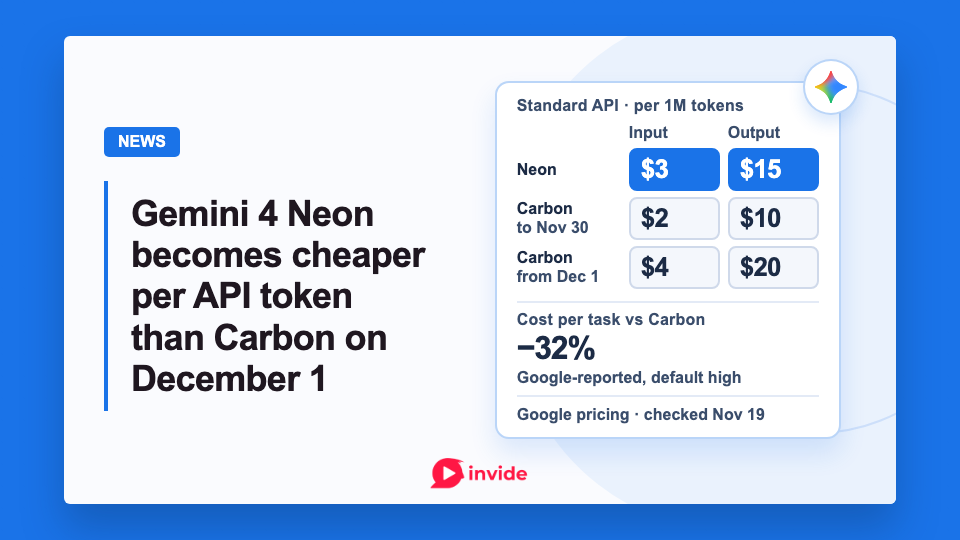
Gemini 4 Neon costs 50% more per standard API token than Carbon through November 30. Google reports 32% lower cost per task for Neon at its default high thinking level. The Gemini Developer API comparison flips on December 1, when Carbon's introductory pricing ends.
Google began rolling out Neon on November 18 at $3 per million input tokens and $15 per million output tokens. Carbon's rates rise from $2 and $10 to $4 and $20 on December 1, putting Neon's rates 25% below Carbon's.
For a fixed run with 100,000 uncached input tokens and 20,000 billable output tokens, the standard token charges would be 60 cents on Neon. The same token counts would cost 40 cents on Carbon through November 30 and 80 cents beginning December 1. That example holds usage fixed and excludes tool charges. When the models take different numbers of calls or generate different amounts of output, the comparison needs the measured totals for each run.
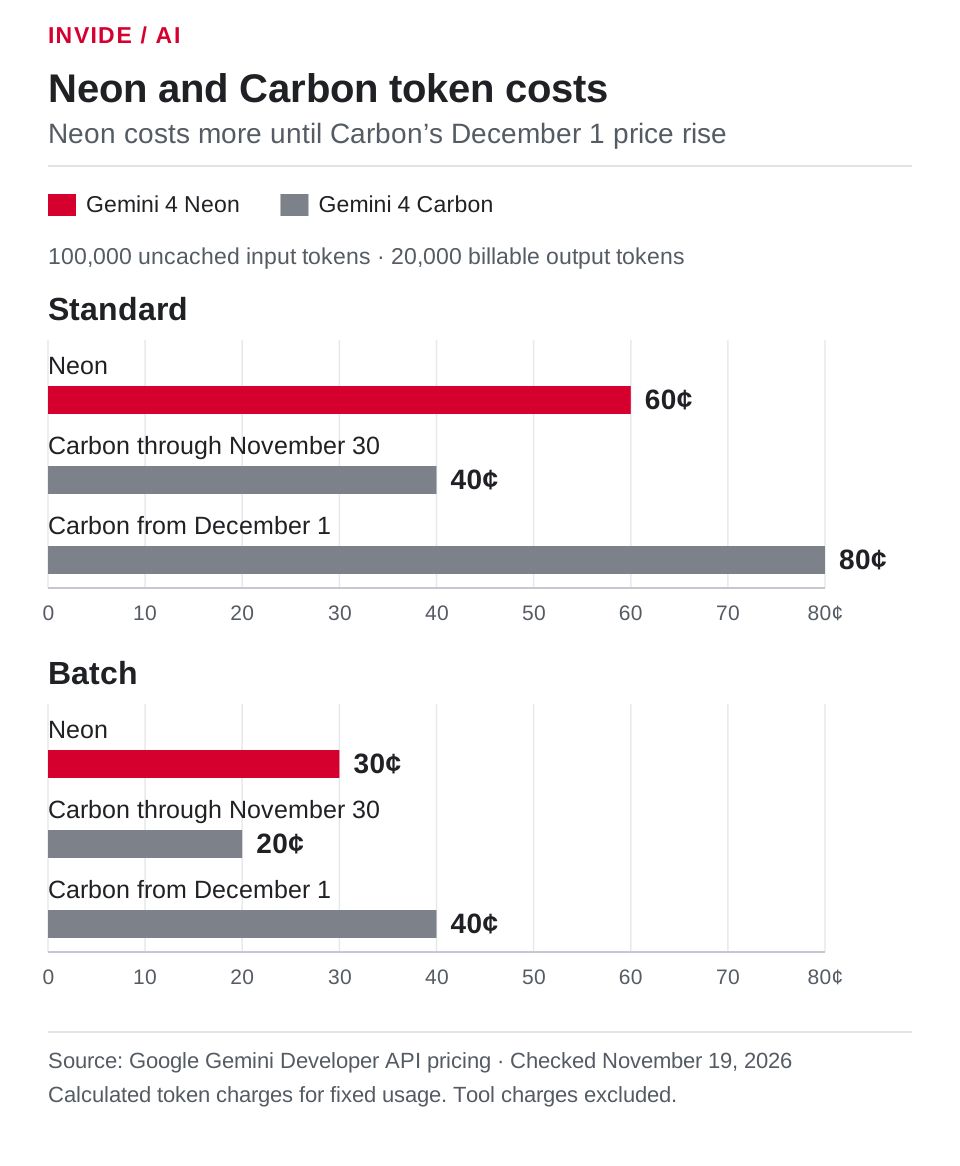
Both groups hold token usage fixed. The bars show listed token charges for the worked example.
What the coding benchmarks show
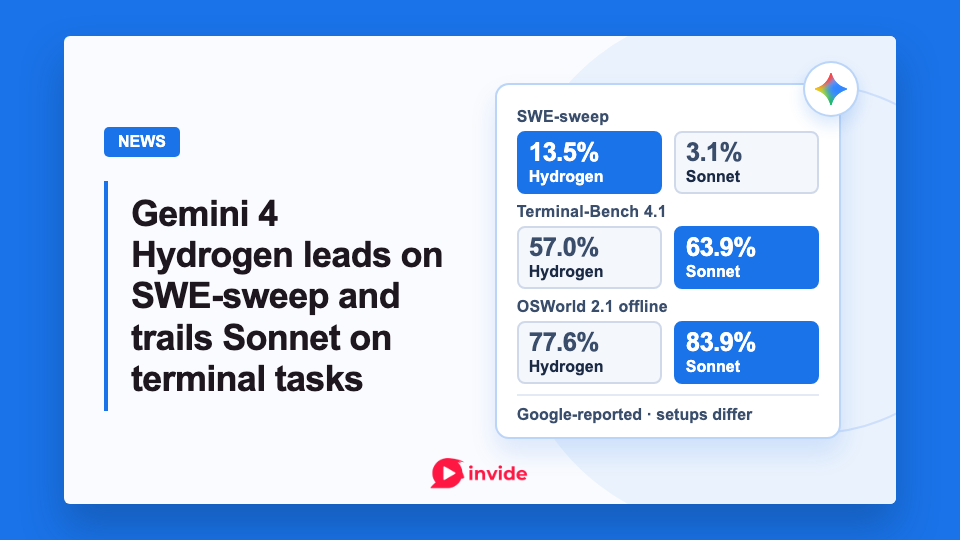
At launch, Google reported that Neon ranked first on the Artificial Analysis Coding Agent Index with a score of 58.6. In the results below, Neon led both rivals on SWE-sweep and beat Opus 5.5 on CursorBench. Opus scored slightly higher on Terminal-Bench and FrontierCode.
| Benchmark | Gemini 4 Neon | Claude Opus 5.5 | GPT-6.2 Sol |
|---|---|---|---|
| Terminal-Bench 4.1, cheating-adjusted accuracy | 65.2% | 65.8% | 61.5% |
| FrontierCode 2.0 | 46.2% | 47.3% | 43.8% |
| SWE-sweep, provider harness | 39.0% | 10.1% | 8.3% |
| SWE-sweep, shared mini-SWE harness | 12.8% | 3.6% | 11.6% |
| CursorBench 4.1, reported by Cursor | 65.4% | 58.1% | Unreported |
Google generally uses provider-reported results for rival models. The Terminal-Bench and FrontierCode comparisons draw on public leaderboards, Google ran SWE-sweep, and Cursor supplied CursorBench. Neon evaluation methodology
Google's methodology specifies the highest thinking setting for Neon unless noted. Among these coding results, FrontierCode explicitly uses high. Artificial Analysis supplied the Neon Terminal-Bench score, run with Antigravity CLI 1.5.9 and reported as cheating-adjusted accuracy.
Both SWE-sweep rows report subtask-weighted reward. The provider setups used Antigravity CLI for Neon, Claude Code for Opus, and Codex for Sol. Google points to Antigravity CLI's built-in subagent tool, which lets agents search different parts of a codebase in parallel for bugs. Neon's lead over Sol narrowed from 30.7 percentage points with the provider harnesses to 1.2 points with the shared harness.
On the Artificial Analysis Intelligence Index v5.0.1, Neon scores 61 at its highest thinking level, xhigh, and 60 at its default high. Google's results table lists Claude Opus 5.5 at 59 and GPT-6.2 Sol at 57.
In a separate cost comparison at Neon's default high thinking level, Google says the model "pairs a high Artificial Analysis Intelligence Index score with a 32% lower cost per task than Carbon." The accompanying chart plots cost per task on Artificial Analysis Intelligence Index v5.0.1. Google gives no per-run breakdown or Carbon token rates for the 32% figure. The chart's highest Carbon point sits near $7.75 per task, close to the $7.76 Artificial Analysis listed at $4 per million input tokens and $20 per million output tokens in our earlier coverage. The chart appears to use Carbon's December rates.
Where Neon fits alongside Hydrogen and Carbon
Google puts Hydrogen on fast, everyday execution and Carbon on its hardest long-horizon projects. It positions Neon for complex work that comes up frequently. Try Neon on recurring multi-file fixes while leaving routine edits with Hydrogen and reserving Carbon for investigations that need sustained work across a codebase.
Google also describes Neon acting as an Orchestrator in Antigravity, directing Hydrogen subagents that work in parallel. In an early evaluation quoted in Google's launch post, Glean says Neon matched or exceeded Carbon's overall quality at three times the speed and 60% of the cost.
API limits and where to get access
The API model ID is gemini-4-neon. It has a shared 1,048,576-token window for input and output. Synchronous output defaults to a maximum of 65,536 tokens, and long decode can go up to the full window within that shared budget. The standard $15 output rate includes thinking tokens. Neon supports implicit caching only, at $0.15 per million cached input tokens. Carbon's standard cache rate rises from $0.10 to $0.20 on December 1. Google lists four thinking levels for Neon and defaults to high.
Neon also supports Batch and Flex inference at $1.50 per million input tokens and $7.50 per million output tokens. Carbon Batch costs $1 and $5 per million input and output tokens through November 30, then rises to $2 and $10 on December 1. Priority inference for Neon costs $5.40 and $27 per million input and output tokens, respectively. For standard requests that use Google Search grounding, Google lists 5,000 free search requests per month shared across Gemini 3 and newer models, then $14 per 1,000 requests. The default daily cap is 1,500 Search grounding requests per project. One Gemini request can trigger more than one Google Search query, and Google charges for each query.
Google lists paid Gemini Developer API access in AI Studio and Android Studio. There is no free API tier for Neon. All Google AI Pro and Ultra subscribers can try Neon in AI Studio and select it in the Gemini app. Google also lists Antigravity access for paid Pro and Ultra subscribers. Enterprises can use Neon in Antigravity and through the API or model menu in Gemini for business.
For a recurring job that currently goes to Carbon, run the same cases on both models and keep the token counts, elapsed time, and number of patches that pass review. Price the recorded token usage at December's standard rates, then divide each model's total token charges by the number of patches that pass review.
Member discussion