
Stripe’s reported OpenRouter deal is a reason to audit gateway costs and lock-in
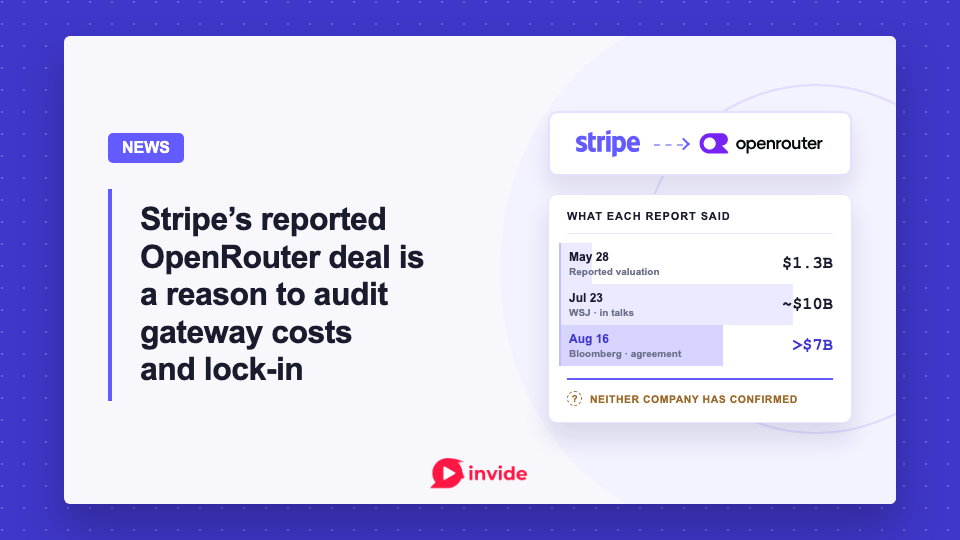
On August 16, Bloomberg reported that Stripe had finalized an agreement to acquire OpenRouter for more than $7 billion. People familiar with the matter told Bloomberg that the final purchase price could change. TechCrunch carried the story the same day. A Stripe spokesperson declined to comment, saying the company does not comment on rumors or speculation. OpenRouter has not confirmed the agreement either. Every outlet running the number is citing Bloomberg's sources.
So treat the Stripe OpenRouter deal as Bloomberg's report, not a company-confirmed announcement.
OpenRouter is an AI gateway that sits between your application and model providers. You integrate once, then switch between Anthropic, OpenAI, or a cheaper open-weight model without rebuilding the integration. The company says it serves 8 million-plus developers across 400-plus models, both figures self-reported. CEO Alex Atallah has described the company as the equivalent of Stripe for AI, which reads differently now than it did in May.
From $1.3 billion to more than $7 billion, with token volume up fivefold
The Wall Street Journal reported on July 23 that Stripe was in talks at around $10 billion. Less than four weeks later, the reported figure is above $7 billion. No cited source states why the figures differ, and the caveat from Bloomberg's sources means the August number is not final.
The increase from May is steep. On May 28, OpenRouter announced a $113 million Series B led by CapitalG, Alphabet's independent growth fund. NVentures and the venture arms of ServiceNow, MongoDB, Snowflake, and Databricks were among the participants. Existing backers Andreessen Horowitz and Menlo Ventures also joined. The round reportedly valued OpenRouter at $1.3 billion.
The company said weekly volume had grown from 5 trillion to 25 trillion tokens in six months, putting it on pace to process more than a quadrillion tokens this year. Those are OpenRouter's numbers, not independently audited usage, but they give the reported purchase price more context than the funding multiple alone.
Stripe and OpenRouter were already connected
A core part of OpenRouter's pitch is that one integration can outlive any single model. A commenter in the r/technology thread described a concrete switching cost it avoids: prepaid balances held by individual providers cannot be withdrawn when you move elsewhere. Centralized billing keeps that money in one account. Money parked with OpenRouter creates the same trap one layer up, replacing model-provider lock-in with dependence on the gateway itself. The two companies were commercially connected well before the acquisition report.
On January 29, Stripe announced that OpenRouter was using Stripe Invoicing, Stripe Tax, and Radar for Fraud Teams. The companies had also connected model routing to Stripe's usage-based billing, allowing Stripe to track usage, apply pricing, and handle billing. This history does not establish why Stripe reportedly wants to buy OpenRouter, but it makes the product fit concrete.
The Hacker News discussion included a useful debate over OpenRouter's durable value: API normalization, or the centralized billing and provider access behind one account? One commenter suggested its prompt traces could be valuable. OpenRouter's documentation says it does not store prompt content unless a customer opts into private logging or product-use settings, and that it has never shared, sold, or licensed prompt data. It does collect request metadata and anonymously categorizes a small sample of prompts using a zero-data-retention model. Provider retention policies still apply separately.
Those are policy commitments, not technical guarantees. A change in ownership makes their durability worth watching.
Measure whether the gateway is earning its keep
Ownership is not the only reason to audit the gateway. A developer in the same r/technology thread argued that OpenRouter is not very useful for long-horizon, multi-turn workflows such as agentic coding. Randomly switching models during a session can destroy prompt-cache hit rates and duplicate cache writes, making token costs quadratic in transcript length. No benchmark was offered, so take it as a hypothesis about your own workload rather than a finding.
A reply agreed about agentic coding but disputed how much enterprise traffic looks like that. At the commenter's workplace, developers can choose from more than a dozen approved models. An MCP tool call that drafts an email does not need a frontier model, and steering that request to a cheaper option can produce substantial savings.
Check the cache hit rate before assuming routing saves money on long, multi-turn sessions. For a spread of short calls across several models, the cache argument mostly does not apply.
What remains open
Bloomberg reports a finalized agreement above $7 billion, with a purchase price that could still change. Neither company has confirmed it. Whether the transaction closes, whether OpenRouter remains a separate product, and whether ownership changes its documented data-use policies or existing contracts remain open. The question worth answering today is whether you could move off the gateway in a week.

Member discussion