
Grok 4.6 arrives with long-running coding agents in focus
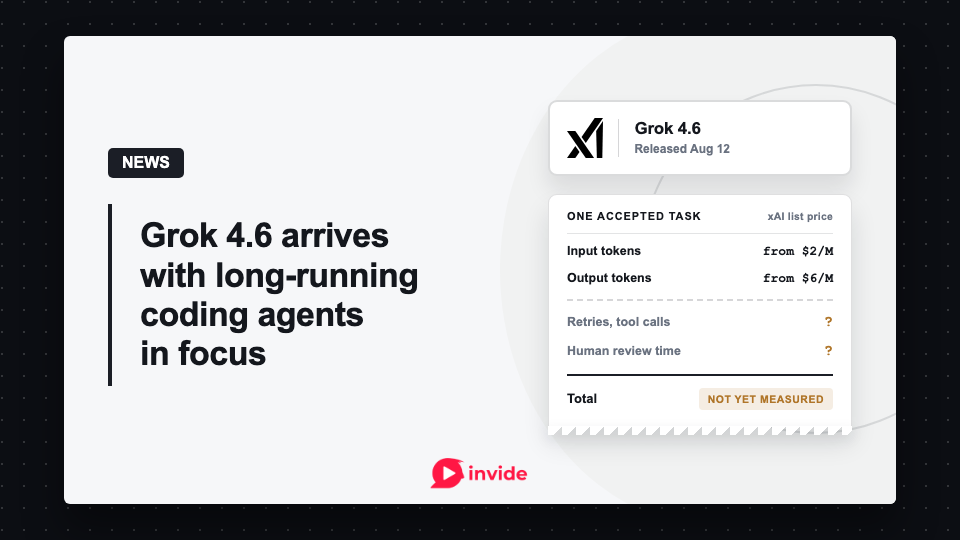
xAI released Grok 4.6 on August 12 with a focus on long-running agents, coding, research, and interactive work. The model is available through the xAI API, Grok Build, Cursor, OpenRouter, Vercel, and Cloudflare.
According to xAI's announcement, pricing starts at $2 per million input tokens and $6 per million output tokens. A faster variant costs twice as much. xAI is also offering twice the included usage in Grok Build and Cursor for the first week.
Developers can put another frontier model into their coding harnesses immediately. Its value will depend on how reliably it completes long, messy jobs and how much work remains for the reviewer.
The bill extends beyond token prices
Long-running coding agents do not consume tokens in a neat, predictable loop. They inspect repositories, call tools, revise plans, recover from errors, and sometimes repeat work. A model with a low token price can still be expensive if it produces verbose traces, needs several retries, or leaves behind changes that require heavy review.
Cost per accepted task is the more useful comparison. That calculation includes failed attempts, tool calls, wall-clock time, and the engineer time needed to inspect the result.
Availability also varies by product. Cursor says Grok 4.6 is available in its coding agent, while xAI lists its own API and several other partners. Access, quotas, and behaviour may differ across those surfaces and the wider Grok product line. Early Reddit discussions included users sorting out those differences alongside introductory usage.
For a team evaluating the model, the sensible test is a representative batch of repository tasks in the harness it actually uses. Measure how often the agent finishes, how often a human has to intervene, and how much of the output survives review.
The benchmarks leave room for repository-level testing
xAI reports improvements over Grok 4.5 across agent and coding evaluations. Its release page compares Grok 4.6 with other leading models on AA Intelligence, GDPVal-AA, DeepSWE 1.1, CursorBench 3.2, and FrontierCode 1.1. The company notes that competitor results come from developers' published system cards or public leaderboards.
The charts offer a starting point for evaluation. Because xAI selected the comparisons, teams still need repository-level tests before drawing conclusions about performance in a particular codebase, toolchain, or review process.
That distinction drove much of the Hacker News discussion. Commenters questioned whether rapid benchmark gains reflect broad capability improvements or increasing optimization around familiar evaluations. They also debated price, task efficiency, trust, and data handling.
Reddit had several active conversations about the launch. The r/grok release discussion mixed early coding impressions with questions about rollout and moderation. A separate r/singularity benchmark thread focused more directly on benchmark interpretation and the cost of producing a successful result. Together, the threads identify the areas practitioners are likely to test first. They cannot establish a change in model quality.
Grok 4.6's availability and starting price are confirmed. Its reliability on long-horizon tasks, review burden, product-specific limits, and cost per completed task remain unverified. Teams can now measure those factors in the coding tools and repositories they already use.
Member discussion