
Zuckerberg says AI should be for everyone. Muse Glimmer is Meta’s first test
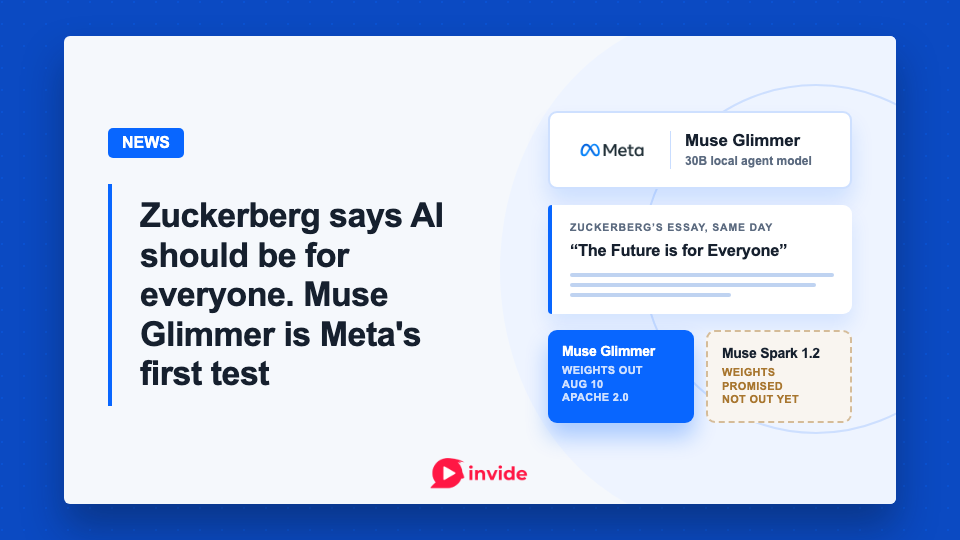
Meta released Muse Glimmer on August 10, the same day Mark Zuckerberg published The Future Is for Everyone, a long argument that advanced AI should be distributed widely instead of controlled by a few companies, governments, or institutions.
The timing makes Glimmer more than another model release. It is the first concrete artifact developers can use to judge Meta’s latest open AI pitch.
According to Meta’s announcement, Muse Glimmer is a 30-billion-parameter open-weight model built for local agent workflows. Meta says Glimmer can run locally on a Mac or PC equipped with one consumer GPU and can handle tasks including coding, function calling, and LLM-as-a-judge evaluation. The weights are available under Apache 2.0.
Developers now have a permissively licensed model they can inspect and run. Zuckerberg’s vision of affordable personal superintelligence for billions of people is considerably broader.
A manifesto with something developers can download
Zuckerberg’s central argument is that concentrating advanced AI creates a larger danger than distributing it. He presents open models, affordable access, private personal agents, and faster American model releases as parts of the same strategy.
Meta did not leave that argument entirely in the realm of policy. Axios reported that the company paired the essay with Glimmer and plans to release weights for a version of the more powerful Muse Spark 1.2 in the coming weeks. Those Spark weights are not available today.
The Associated Press similarly connected the manifesto to Glimmer while noting the obvious tension around Meta’s interests. Open models can distribute technical capability, but Meta still benefits if developers and products build around its ecosystem.
Developers do not have to accept the manifesto’s broad claims to find value in a model that can run without sending every task to a hosted service. Local execution can matter for offline use, private data, experimentation, and workloads where API costs or network access are constraints.
Open weights and reproducible open-source development are different things. Meta is providing a model artifact, documentation, and planned runtime integrations. It is not providing the complete training pipeline, data, or compute needed to recreate the model.
Local does not automatically mean accessible
The Glimmer-specific Hacker News discussion moved quickly to the questions that decide whether a local model is genuinely useful: memory requirements, quantization, inference speed, function-call reliability, and support in existing runtimes.
Those practical limits matter. “One consumer GPU” covers a wide range of hardware, and fitting a model into memory is different from running it at a comfortable speed. Meta says integrations for llama.cpp, MLX, and ExecuTorch are coming, which also means parts of the easiest local path are still arriving.
The broader Hacker News discussion about Meta’s return to open models focused more on strategy and motive. Some participants saw the move as a response to stronger closed-model competitors. Others argued that the motive matters less than the result: more downloadable weights create more competition and give local developers another serious option.
Reddit showed the same split. In r/LocalLLaMA, commenters welcomed Meta’s return to open-weight releases while remaining wary of the company and Zuckerberg. The useful distinction is that distrust of Meta does not make an Apache-licensed model worthless, just as releasing one model does not establish a permanent commitment to openness.
What is settled today is narrower. Meta has released Glimmer’s weights under Apache 2.0 and published a model intended for local agent workloads. What remains unproven is how comfortably it runs across common consumer systems, whether Meta’s benchmark results survive independent testing, and whether the promised runtime integrations and Muse Spark 1.2 weights arrive. Glimmer gives developers something real to test. It does not yet prove Zuckerberg’s larger argument about distributing AI power.
Member discussion