
Claude’s output marks are here, but developers still lack the details to test them
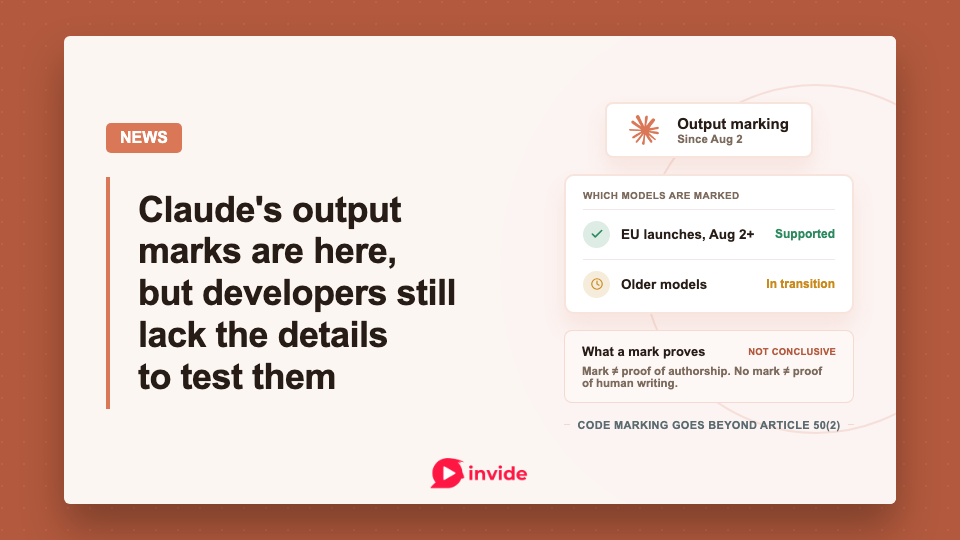
Anthropic updated its Claude Help Center guidance on August 11, saying Claude models launched in the EU on or after August 2 support machine-readable marking at launch. Generated text carries an embedded watermark, while supported files can receive signed provenance metadata using the C2PA standard.
Anthropic says the marking applies worldwide wherever supported Claude models are offered. That includes the API, Claude, Claude Code, Claude Cowork, and Claude Tag, although the company also warns that some platforms or features may not support every marking type.
Anthropic is still working to add marking to models released before August 2. That's narrower than some discussion suggests: support begins with models launched in the EU from August 2, while older models remain in transition. In practice, Claude output watermarking may vary by model even without a visible change in responses.
A watermark is not proof of authorship
The update is part of Anthropic’s commitments under the EU AI Act’s Article 50(2) transparency code, whose relevant obligations began applying on August 2. The European Commission describes the code as voluntary guidance. Anthropic is implementing the marking at the model layer so it can follow output across Claude products and surfaces. For systems placed on the EU market before August 2, the Commission’s Article 50 FAQ says providers have until December 2, 2026 to comply; pre-August 2 content does not need retroactive marking.
That does not turn the mark into a reliable authorship label. Anthropic says a detected mark indicates that content may have been processed by Claude. Someone may have used Claude to proofread, translate, summarize, or convert material that began elsewhere. The resulting text can still carry a Claude mark.
The inverse is also important. A missing mark does not establish that text was written by a person or that Claude was not involved. Anthropic lists heavy editing, paraphrasing, translation, short passages, stripped file metadata, and unsupported features as reasons a mark may not be detected.
The community reaction is less measured than Anthropic’s rollout note. The Hacker News discussion dives into token selection, detector length, and what happens when an agent refactors code. The r/claude and r/ClaudeAI threads are blunter: some commenters treat code-quality degradation as settled, while others direct their anger at the EU or Anthropic. That is backlash, not a benchmark. It does put the practical question in sharper terms: can developers trust the provenance signal without paying for it in output quality?
Code output is the harder test
The legal baseline is narrower than Anthropic’s product choice. The Commission’s Article 50 FAQ lists source code, short sequences of numbers, symbols, or letters, and machine-to-machine outputs not exposed to humans among categories outside the marking obligation. Anthropic is therefore choosing to mark code more broadly than the minimum Article 50(2) requirement, at least under that guidance.
Anthropic says the text mark can travel through copy-paste and may survive some editing. It also says the watermark does not change the response’s meaning, quality, or readability. The company has not yet published the technical documentation needed to test those claims on code, short snippets, structured output, or tool-call arguments.
That gap matters more for developers than ordinary prose. Code assistants make small, constrained changes: renaming variables, changing signatures, and rewriting queries. A subtle model-level constraint deserves testing here. It is too early to say Claude’s marks break code, but “no change in quality” is not independently demonstrated for coding workflows.
File provenance has a more familiar weakness. C2PA metadata can provide a useful chain of information when it remains attached to a supported file, but format conversion, re-saving, screenshots, or other processing can strip it. Anthropic acknowledges those limitations in its own guidance.
For teams, treat a Claude mark as a provenance signal rather than an authorship verdict. Do not automatically reject code or prose if Anthropic’s future detection mechanisms flag it, and do not assume an unmarked passage is human-written. Until Anthropic publishes those mechanisms and error boundaries, a Claude mark is best treated as a non-conclusive provenance signal. AI watermark detection is a future workflow question, not a current gate. Check which model versions your workflow uses and whether your pipeline preserves file metadata.
Anthropic is making AI-generated content marking part of model behavior rather than a visible label added after generation. That is a meaningful shift. The practical test now is whether developers get enough information to understand the signal, its error boundaries, and its effect on the short, structured outputs that software teams rely on.
Member discussion