
An XSS in a low-priority app can compromise your entire Auth0 tenant
Security consultancy elttam shared a new technical report on June 22 showing how an XSS vulnerability in one application can be chained with Auth0 configuration defaults to reach other applications and APIs in the same tenant.
The research, which was also discussed on r/netsec, does not describe a vulnerability that independently compromises Auth0. An attacker first needs a working cross-site scripting flaw and several additional conditions. Still, the attack is useful because it shows how a bug in a relatively unimportant application can cross boundaries developers may have assumed were enforced by the identity platform.
The main issue is Auth0's support for the OAuth Implicit Grant Flow. According to elttam, this older flow remains enabled by default for Auth0 applications, even though Auth0 no longer recommends it for retrieving access tokens.
The attack starts with an ordinary XSS flaw
The researchers built an environment with two applications in the same Auth0 tenant. One was a regular web application containing an XSS vulnerability. The other was an administrative single-page application connected to a protected backend API.
Under normal conditions, the vulnerable application could not retrieve an access token directly. It used the Authorization Code Flow, which required a client secret during the token exchange. Its authentication proxy also stored the resulting session in a cookie rather than exposing the access token to the browser.
The researchers worked around this by initiating the Implicit Grant Flow from inside the vulnerable application.
Unlike the authorization code flow, the implicit flow returns an access token in the URL fragment. JavaScript running through the XSS vulnerability could open an authorization window or iframe, wait for Auth0 to redirect it, and then extract the token from the resulting URL.
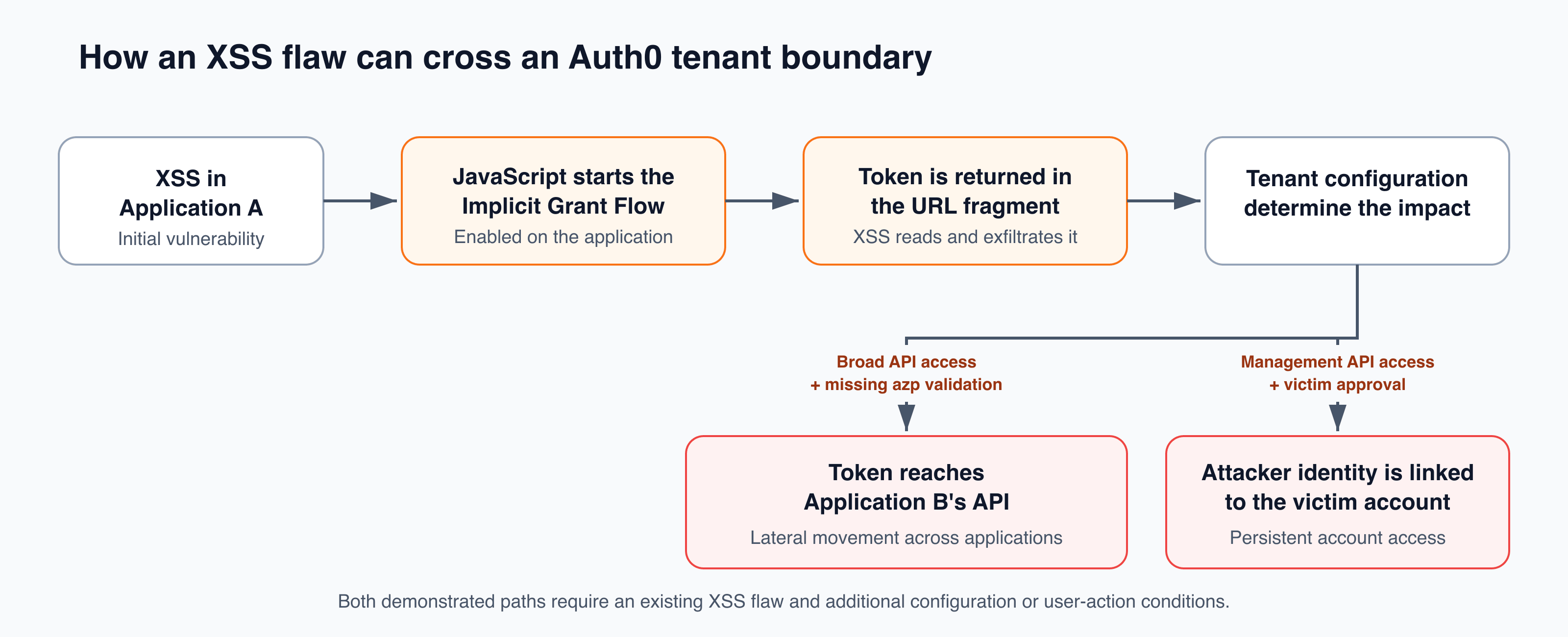
The token could request an audience belonging to another API in the same tenant. If that API allowed access from every Auth0 application, and its backend did not verify the token's authorized-party or azp claim, the attacker could use it to reach a resource that the vulnerable application was never intended to access.
This is where the report becomes more than another warning about XSS. The XSS flaw provides the initial execution, but tenant-level trust decisions decide how far the attacker can go.
Restricting the API may not close every route
An obvious defence is to restrict each Auth0 API to approved applications and validate the azp claim in the backend. The researchers tested that setup as well.
They found another possible attack path through the Auth0 Management API, which can provide applications with limited user-level access. One available permission, update:current_user_identities, allows a user to link another identity to their account.
In the demonstrated attack, malicious JavaScript requested this scope and presented the victim with an Auth0 consent prompt. If the victim approved it, the attacker could obtain a token and link an attacker-controlled identity to the victim's account.
This part of the chain requires the victim to approve the additional permission, so it is not a silent account takeover. The attacker would need to make the request appear routine or expected. The concern is that the consent screen appears as part of a trusted application's authentication flow, and a user may approve it without understanding that the requested permission can modify the identities connected to the account.
Once the attacker's identity is linked, the compromise can persist beyond the original browser session.
Auth0 tenants need to be treated as shared security boundaries
The attack is conditional. It requires an XSS vulnerability, the Implicit Grant Flow, permissive access configuration or Management API access, and in some cases victim interaction. The report does not establish that every Auth0 deployment is vulnerable, nor does it present evidence of these techniques being exploited in the wild.
It does show why authentication defaults need the same scrutiny as application code. Teams often use a common Auth0 tenant for several products, internal tools and administrative interfaces. This is convenient, but it also means those applications are not completely unrelated from a security perspective.
For teams using Auth0, the immediate review is fairly concrete:
- Disable the Implicit Grant Flow on applications that do not require it.
- Restrict each API to explicitly approved Auth0 applications.
- Validate the
azpclaim in backend APIs rather than accepting any otherwise valid token. - Disable user access to the Auth0 Management API when it is unnecessary.
- Handle identity linking through a trusted backend instead of exposing it directly to browser applications.
- Require a fresh authentication challenge before account linking or other sensitive identity changes.
- Review every application sharing the tenant, including smaller internal tools that may receive less security attention.
The practical question is not only whether each application is secure on its own. It is whether a compromised application can use the shared identity tenant to reach anything else.
Member discussion