
How to build a startup engineering team that owns its work
A startup hires two engineers to build a customer-facing product. One starts work on the application; the other begins setting up infrastructure. A month later, both have made progress, but neither knows who is responsible for deciding what goes into the first release. Each of them takes questions to the founder in separate conversations. So when a customer request changes the priority, only the engineer who asks next hears about it, and the other keeps building toward the old plan.
Both engineers did their work. The team had no agreed owner for release decisions and no shared place to record a changed priority. The founder also had not decided which calls the engineers could make without approval.
Those gaps affect more than the first release. They shape whom the startup hires next, what a new engineer learns first and how much work keeps coming back to the founder. The fix starts with a list of the decisions the team owns.
Define the work before filling the roles
Before writing a job description, identify the outcomes the team is responsible for. An early product team could be preparing its first release while supporting early customers. A growing team could be making an existing service reliable while adding features.
List the decisions that come with those outcomes. Who decides which customer problem to address? Who can change the data model? Who handles an incident? Who needs to be consulted before a release? One person does not have to make every decision, but the team should know how each decision gets made.
This exercise also exposes gaps in a hiring plan. If production incidents are interrupting feature work, seek experience diagnosing and operating services. If a technical lead is already in place but no one owns a product area, look for someone who can take it on. When a founder is the only person setting technical direction and mentoring engineers, consider a lead who can share those responsibilities.
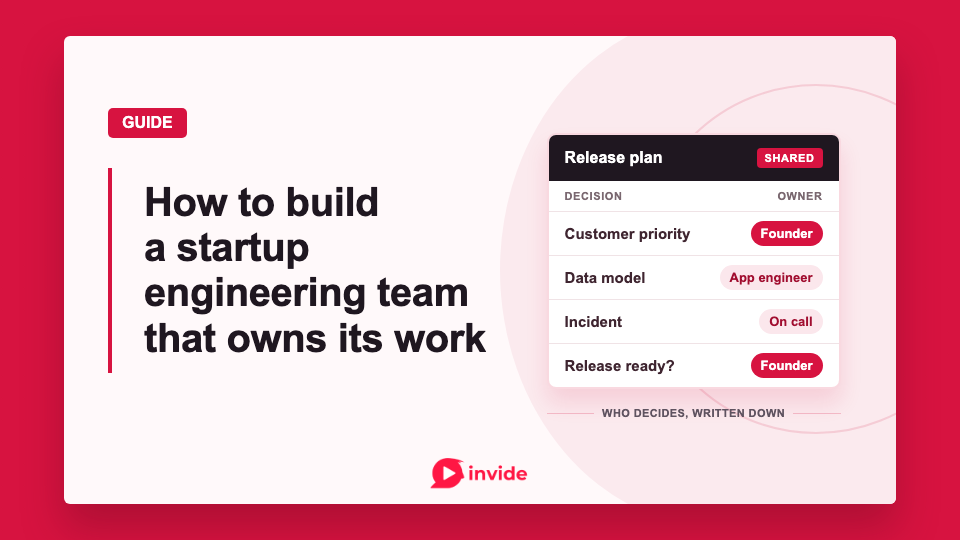
The table below shows one possible split for the opening example. The founder and engineers should agree on the names and record them with the release plan.
| Decision | Owner | Consulted | Where to record it |
|---|---|---|---|
| Which customer problem to prioritize | Founder | Engineers and customer-facing teammate | Release plan |
| How to change the data model | Application engineer | Infrastructure engineer | Design note or pull request |
| How to respond to an incident | Engineer on call | Other engineer; founder if customers are affected | Incident notes |
| Whether the release is ready | Founder | Both engineers | Release checklist |
Write down what the team owns and what sits outside its authority. If engineers can choose an implementation but need approval to change a customer's contract, make that boundary explicit. Revisit it when another person joins or an owner takes on a new responsibility.
Hire for the work and be honest about the conditions
A startup competing with a larger company can give candidates a clear account of the work, the people they will work with and the decisions they will be able to make. Be direct about compensation, resources and the risks of joining an early-stage company.
Describe the actual problems in the role. Instead of asking for a person who can "build scalable systems," explain whether the immediate need is to stabilize a payment integration, build a mobile product, or make an existing application easier to deploy. Separate skills needed on day one from things the person can learn on the job. A long list of required tools can hide what the role is meant to accomplish.
Use the same core questions and assessment criteria for candidates interviewing for the same role. Google's structured interview guide describes its use of role-relevant questions, a shared scoring rubric and interviewer calibration. A small team can adapt the principle without copying Google's entire hiring process.
For example, give candidates a short description of a service that fails when a dependency is unavailable. Ask how they would investigate it, what information they would want and how they would decide on a fix. Agree beforehand on the qualities to look for, such as how the candidate tests assumptions, considers customer impact and communicates uncertainty. Give interviewers room for follow-up questions while using the same core criteria.
Make the process proportionate to the job. Tell candidates what each stage assesses, how long it will take and when they can expect a decision. If an exercise requires substantial work, consider compensating candidates. The interview is also a chance for a candidate to learn about the team's expectations, technical challenges and working conditions.
Avoid treating "culture fit" as shorthand for whether someone feels familiar. Describe the behaviors the team needs instead. If an engineer will work with a distributed team, assess how they communicate decisions and ask for help. If the role involves customer conversations, ask about a time they worked through competing requirements.
Our guide to hiring your first tech team covers how to attract early employees. Compare its pay advice with current market rates before you use it.
Give new engineers a way into the team
A new hire needs access to the repository and a working development environment. They also need to know why the system works as it does, who can answer questions and what a good first contribution looks like.
Microsoft researchers studying onboarding interviewed 32 developers who had moved into teams and 15 engineering managers. They connected onboarding tasks with learning, confidence building and socialization. Their case study took place at one large company; a small startup can use those three areas to plan an engineer's first assignment.
Before the person starts, prepare the following:
- Arrange access to the tools and repositories needed for the first assignment. Check the setup instructions.
- Name a point of contact and plan introductions to the people who can explain the product and codebase.
- Choose a small task with a clear outcome and identify a reviewer who has time to help.
The first assignment should lead somewhere beyond a green test. A small bug fix might introduce the engineer to a customer problem, a service, the deployment process and a reviewer. Have someone available to explain the unfamiliar parts, then ask the new hire what was difficult to find or understand. Their questions can improve the next person's onboarding.
For a remote hire, make introductions and opportunities to ask questions deliberate. A survey of 267 Microsoft new hires who joined software teams during the pandemic identified building a strong team connection as one of the biggest challenges. Most had onboarded remotely and never met their teammates in person. A named buddy, a conversation with a product teammate and regular check-ins give a new engineer people to approach.
For any new hire, check in at the end of the first week and ask the engineer to show their first change and describe what was hard to find. At the end of the first month, discuss which part of the product they can take on next and where they need support. These are check-in points, not deadlines for mastering the codebase.
Make goals and decisions visible
People can work hard on separate tasks and still pull in different directions. Set a shared goal that explains the customer or business result, then connect the work to it. "Reduce the time customers wait for a report" gives the team more context than a list of tickets to close.
Discuss the tradeoffs before work begins. For a first release, which failures can the team tolerate? What must be tested? Who will handle support? When the goal changes, tell the people doing the work and explain what is no longer a priority. Recording the decision in the place the team already uses for planning helps someone who missed the conversation catch up.
Take the founder out of the approval queue
A shared goal tells engineers what to work toward. They also need to know which decisions they can make without waiting for the founder.
In a small startup, the founder can hold context about why the system was built a certain way and what each customer was promised. When that information stays in separate conversations, engineers can be left waiting for answers. Look at the decisions that reach the founder in a typical week. Which ones affect a customer commitment, budget or company risk? Which are implementation choices an engineer could make with the right context?
Pick one recurring decision to delegate. For example, let an engineer choose the implementation for a reporting feature within the agreed requirements and budget, then review the result together. Record the decision and what would require escalation. When priorities change, update the shared release plan.
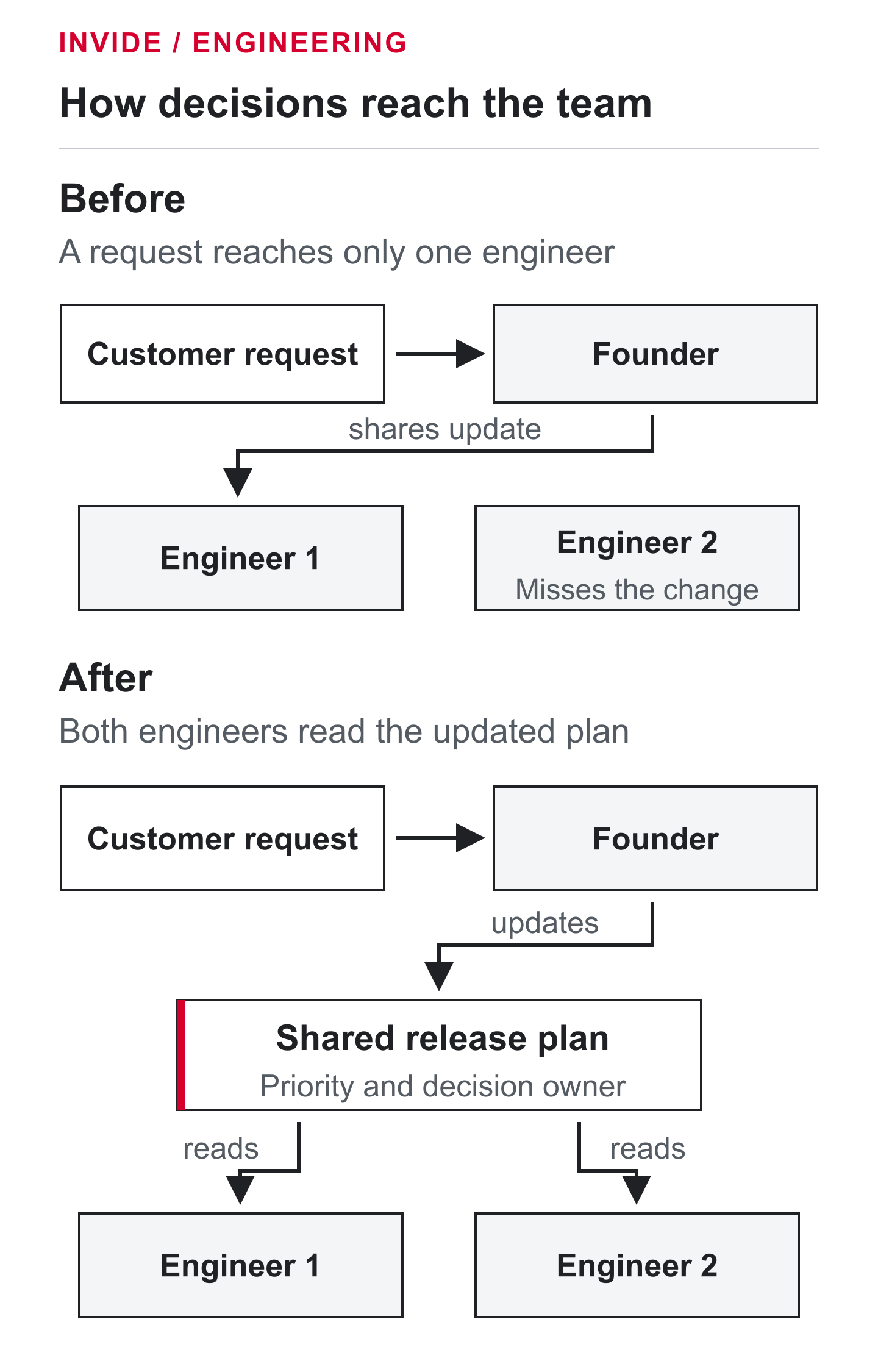
This hypothetical example shows one way to share a changed priority and its decision owner.
If the founder no longer has time to set technical direction, review difficult changes and coach engineers, consider giving an existing engineer explicit lead responsibility or hiring a technical lead. A people manager can help when regular feedback, development and coordination need dedicated attention. The choice depends on the work that is going unattended and whether someone has the skills and time to take it on, not a fixed team size.
Our guide to effective delegation covers setting expectations and providing support when handing work to another engineer.
Make feedback and disagreement part of the work
Engineers need to be able to question a plan, point out a risk and ask for help. A team also needs a way to reach a decision when people disagree. Leaving every conflict to resolve itself can allow a technical disagreement or an interpersonal problem to persist.
Start by making the disagreement specific. Two engineers may both want a reliable release but differ on whether a migration can happen safely in one step. Ask each to explain the failure they are concerned about and the evidence that would change their view. Choose a next step: run a small test, consult the owner of the affected service or agree on a rollback plan. If the team still cannot agree, the person responsible for the decision makes the call and records the reasoning.
Managers also need to intervene when the issue is about how people treat each other. Discuss the behavior privately, hear the people involved and agree on what needs to change. A decision record will not resolve repeated dismissive comments or a pattern of excluding someone from discussions.
Code review is one place to practice useful feedback. Explain the concern and its consequence. Ask a question when intent is unclear, and distinguish a release-blocking problem from a preference. In a Microsoft study of code review, finding defects was a main motivation, but the researchers found that reviews focused less on defects than expected. They also identified knowledge transfer and team awareness as benefits.
Help people grow into larger responsibilities
A growing team needs more people who can make decisions, understand customer needs and help others. Do not wait for a promotion cycle to discover whether an engineer wants or is ready for that work.
Ask people what they want to learn and look for an assignment with a real decision attached. An engineer might lead a small project, coordinate a release, mentor a new hire or investigate a recurring incident. Agree on the outcome and where they can make decisions independently. Check in at points where they can still change course, not only after the work is finished.
Coaching can mean asking questions or sharing expertise, depending on what the person needs. Google's manager guidance calls these facilitating and teaching. An engineer diagnosing an unfamiliar outage might need an experienced colleague to explain the system; someone planning their first project can discuss options before choosing an approach.
Give feedback close enough to the work that the person can act on it. Be specific about what happened, its effect and a next step. Invite feedback in the other direction too: a manager may learn that a priority changed without explanation or that an engineer lacks the authority needed to own an outcome.
When engineers use coding agents, check whether they understand the changes they submit as well as whether those changes work. Agree on who owns a change, what access an agent receives and how the team checks its work. Ask a newer engineer to walk a reviewer through an agent-assisted change, including what they tested and what they still need help understanding. In an Anthropic experiment, 52 mostly junior engineers learned an unfamiliar Python library with or without an AI assistant. The assisted group averaged 50% on an immediate quiz, compared with 67% for the hand-coding group. In a separate qualitative analysis, higher-scoring participants included people who asked conceptual questions or requested explanations; those usage patterns were observed, not randomly assigned. The short experiment did not measure long-term workplace learning or coding agents specifically.
Check whether the team can deliver and learn
Task counts alone say little about whether customers received a useful change or whether the team can maintain it. Review the path from an agreed piece of work to release and support. Where does work wait? How often does the team need to revisit a change? Are incidents concentrated in an area only one person understands?
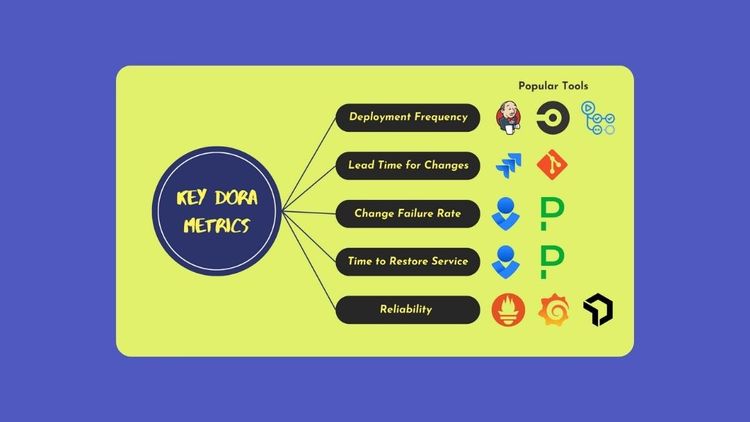
DORA's delivery metrics group five measures under throughput and instability:
| Measure | Group | What it measures |
|---|---|---|
| Change lead time | Throughput | Time from code commit to production. |
| Deployment frequency | Throughput | How often changes reach production. |
| Failed deployment recovery time | Throughput | Time to recover from a failed deployment requiring immediate intervention. |
| Change fail rate | Instability | Share of deployments requiring immediate intervention, such as a rollback or hotfix. |
| Deployment rework rate | Instability | Share of deployments that are unplanned and result from a production incident. |
Use the measures for the application or service the team owns, alongside customer feedback and the engineers' experience. Agree on definitions before comparing periods, and look at the changes behind the numbers. For example, a longer lead time may reflect a slow review queue or a difficult migration.
Our DORA metrics guide covers ways to collect delivery data. DORA has since updated its metrics, so use the table above for the current definitions.
At the next team check-in, choose one recurring problem to investigate. If reviews repeatedly wait for one engineer, reserve review time or pair another person with them. If new hires cannot run the application, fix the setup path with the next hire. After a few weeks, look at the queue or repeat the setup and ask whether the change helped.
For the two engineers in the opening example, the founder can begin by naming a release decision owner and writing the current priority in a shared plan. At the next check-in, the three can review any decisions that waited for the founder and decide which one an engineer will own next. As the team grows, revisit those boundaries with the people doing the work.


Member discussion