
OpenAI made GPT-5.6 Luna five times cheaper. That does not make every model cheaper
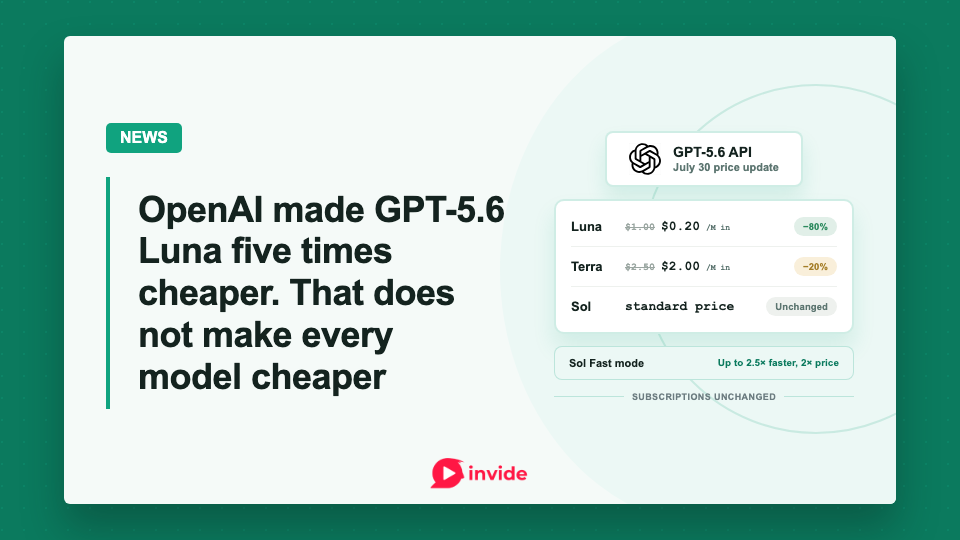
OpenAI cut the price of GPT-5.6 Luna by 80% and Terra by 20% on July 30, three weeks after releasing the GPT-5.6 model family. The new API prices are already in effect.
Luna now costs $0.20 per million input tokens and $1.20 per million output tokens, down from $1 and $6. Terra now costs $2 per million input tokens and $12 per million output tokens, down from $2.50 and $15.
The distinction matters because the change is already being compressed into a more dramatic version: OpenAI made its models five times cheaper. Only Luna received that reduction. Terra got a smaller discount, while the standard price of the flagship GPT-5.6 Sol model did not change. ChatGPT and Codex subscription prices are also unchanged.
Taken together, the OpenAI GPT-5.6 price cut changes the floor for AI agent costs, but the effect differs sharply by model. GPT-5.6 Luna pricing fell dramatically; GPT-5.6 Terra pricing moved much less.
For developers running large numbers of agent tasks, Luna's cut is still substantial. The same token budget now buys five times as much Luna usage. Whether it produces five times as much useful work is a separate question.
Lower token prices can change where Luna fits
Smaller models are often used for the repetitive parts of an agent workflow: applying a well-defined code change, classifying documents, running checks, or processing many similar requests. At the old price, the gap between using Luna and reaching for a more capable model may not have justified the quality tradeoff. An 80% reduction makes that routing decision worth revisiting.
It does not make list price a sufficient evaluation. A cheaper model can still cost more per completed task if it needs additional retries, produces longer answers, makes unnecessary tool calls, or frequently escalates work to another model. Quality failures can matter far more than token savings when the task touches production code or customer data.
OpenAI attributes the price reductions to improvements across its models, inference systems, and agent harness. The company says GPT-5.6 Sol helped optimize production kernels and token generation, though those internal cost improvements have not been independently verified. Axios separately confirmed the Luna and Terra price changes.
The practical response is to rerun existing evaluations rather than assume Luna now replaces another model. Compare cost per successful task, not just cost per token. Include retries, tool calls, latency, and the rate at which a human or stronger model has to repair the result.
Codex users get cheaper usage, not larger quotas
The lower prices also affect how Terra and Luna usage is counted in paid ChatGPT Work and Codex subscriptions. OpenAI says both models now consume fewer credits. The subscription prices and quota budgets themselves remain the same.
That qualification came up quickly in the Reddit discussion. The most useful correction was also the simplest: Luna is five times cheaper, Terra is 20% cheaper, and Sol is unchanged. Other developers said the reduced credit consumption could make Luna practical for Codex workloads that previously exhausted their allowance too quickly.
In the Hacker News thread, some practitioners described model-routing stacks that use cheaper models for parallel exploration or execution and Sol for synthesis. Others pointed to their own evaluation results when deciding whether to switch. Those comments support rerunning evaluations by model, but they sit alongside wider discussion of benchmarks, inference speed, and competitive price pressure. They are community reaction rather than evidence of Luna's quality.
GPT-5.6 Sol Fast mode is a faster lane, not a discount
OpenAI also replaced its Priority Processing option with Fast mode for the API. For GPT-5.6 Sol, the company advertises speeds up to 2.5 times faster than Standard processing at twice the price. Existing API requests tagged as priority will automatically use Fast mode.
This gives teams a different tradeoff at the top of the range. Luna and Terra are cheaper for cost-sensitive work; Sol's new option charges a premium when latency matters. “Up to 2.5 times faster” is not a guarantee for every request, so sustained workloads will need their own latency measurements before paying double.
The price cut makes Luna easier to experiment with, especially for parallel agents and routine implementation work. Its real value will be determined by completed-task economics: whether the cheaper model can meet a team's quality threshold without giving the savings back through retries, supervision, and rework.
Member discussion