
Qwen released its new Max model, but the open weights are still a promise
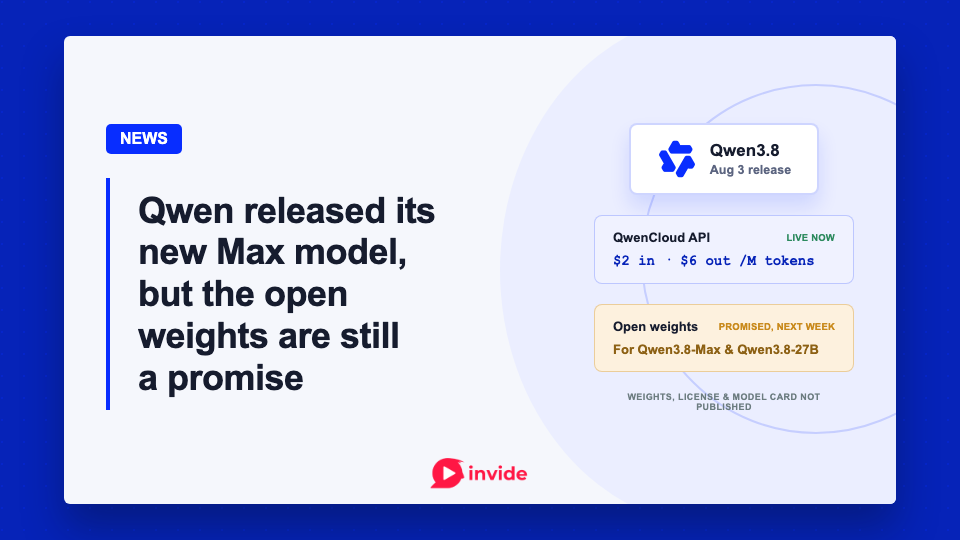
Qwen formally released Qwen3.8-Max on August 3, calling it the company's most capable model so far. It also said the model's weights will be released next week, marking the first time Qwen has committed to opening the weights of a Max-class model.
A separate Qwen3.8-27B model is due to receive open weights next week as well. That smaller release may end up being the more immediately useful one for developers who want to run a model on their own hardware rather than call a hosted service.
There is an important timing distinction here. Qwen3.8-Max did not first become usable today. A preview appeared on Alibaba's Token Plan, Qoder, and QoderWork on July 19. What changed is the formal Qwen3.8-Max release and a more concrete commitment about when the downloadable weights should arrive.
For now, developers can evaluate the hosted model through an API with concrete pricing. QwenCloud lists Qwen3.8-Max at $2 per million input tokens, $6 per million output tokens, and $0.25 per million implicit-cache input tokens. That availability is separate from an open-weight release: developers still cannot inspect the final license, download the promised weights, or test community quantizations.
QwenCloud describes Max as a mixture-of-experts model with 2.4 trillion total parameters. It does not disclose the active parameter count, which is more useful for understanding the computation required for each token. The total alone is therefore not a sound basis for estimating VRAM, generation speed, or local serving cost.
The 27B model could be the practical release
Max carries the flagship label, but the Qwen3.8-27B announcement drew much of the practical interest in the LocalLLaMA discussion. People asked about support in tools such as llama.cpp and vLLM, and about what memory configurations might make the model usable.
Those are sensible questions, but there are no released artifacts or implementation tests to answer them yet. Buying hardware or redesigning a local setup around community guesses would be premature.
The interest is still understandable. A 27B model sits closer to the range that local-model users already build systems around. If Qwen ships it with a workable license and timely inference support, developers could evaluate it without depending entirely on Alibaba's hosted environment. That would make comparisons based on real workloads, controlled prompts, and known hardware possible.
The release cannot be judged from its benchmarks alone
Qwen positions Qwen3.8-Max as its strongest model and presents it as a coding and agentic-work model. Those are vendor claims until independent users can test the final release under disclosed conditions.
The Hacker News discussion raised the useful questions: what materially changed from the July preview, how token and reasoning efficiency compare, and whether benchmark results disclose enough about the budgets used. The thread also showed why today's wording matters. A hosted model being formally released is different from open weights being available.
The same caution applies to early Reddit reactions. Enthusiasm for a local 27B option demonstrates demand, not model quality. Reports about earlier Qwen models or the hosted preview do not establish how the downloadable Qwen3.8 versions will behave.
The real test begins when Qwen publishes the weights, license, model card, and enough implementation detail for inference projects to support them. Until then, Qwen3.8-Max open weights are a notable commitment with a short deadline, while Qwen3.8-27B remains the potentially practical part of the announcement.
Member discussion