
Claude Fable 5.1 makes caching cheaper and breaks three API behaviors
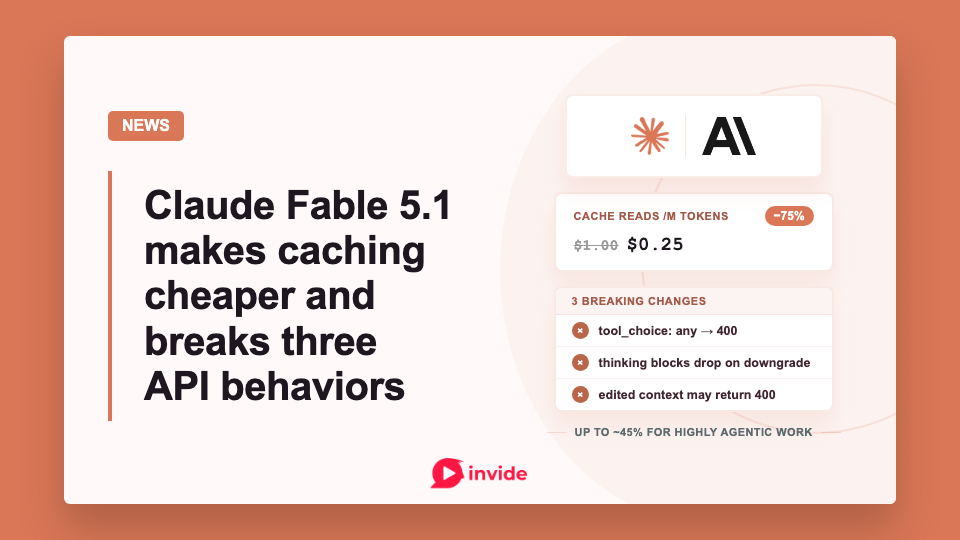
Anthropic released Claude Fable 5.1 on September 1 with cheaper caching for long-running agents. Cache reads now cost $0.25 per million tokens, 75% less than Fable 5. Base pricing remains $10 per million input tokens and $50 per million output tokens.
Anthropic estimates that the lower rate will reduce typical token-billed workload costs by about 25%, and by up to roughly 45% for highly agentic work. Actual savings depend on the workload. Cache writes remain $12.50 per million tokens for five minutes and $20 for one hour, while the minimum cacheable prompt remains 512 tokens.
The discount depends on how the agent works
Prompt caching pays off when an agent repeatedly reads the same repository map, instructions, and tool definitions. On Fable 5.1, cache reads cost one-fortieth of base input, compared with one-tenth on other Claude models. Workloads that rebuild context, generate large outputs, or retry failed steps will save less.
Fable 5.1 defaults to high effort on the API and in Claude Code, and to medium in Cowork and claude.ai. Anthropic's announcement says low or medium effort can produce results similar to or better than Fable 5 at lower cost. Its migration guide separately tells teams to start at high and run a fresh effort sweep on their own evaluations.
Agent behavior can also consume part of the saving. Anthropic says Fable 5.1 may issue one tool call per turn where Fable 5 batched several implied independent calls. That adds tokens, round trips, and wall-clock time. It is also more likely to rewrite a whole file for a small edit, producing more output tokens. Both behaviors have prompting fixes in Anthropic's Fable 5.1 guidance.
Plan access adds another distinction. Anthropic's support page says Max and premium Team or seat-based Enterprise users can spend up to half their weekly limits on Fable models before switching or buying usage credits. Pro and standard Team seats use pay-as-you-go credits from the first token. Claude Code requires version 2.1.250 or later.
Migration starts with two blockers and three breaking changes
Before changing code, check whether the model can run in the target workspace. Fable 5.1 requires 30-day data retention and returns a 400 invalid_request_error without it, unless Anthropic expressly authorizes zero data retention. Neither Fable 5.1 nor Mythos 5.1 supports Anthropic's Priority Tier, while Fable 5 does.
The detailed what's-new documentation then identifies three breaking changes.
Forced tool use no longer works. Setting tool_choice to any or naming a specific tool returns a 400 invalid_request_error; auto and none are unchanged. Anthropic recommends explicit instructions with strict tool schemas or structured outputs instead.
Thinking blocks move forward but not backward across models. Fable 5.1 can read blocks produced by earlier Claude models, while earlier models cannot read its blocks. A router or fallback that downgrades mid-conversation silently drops them unless the request uses the thinking-binding-controls-2026-08-01 beta header to report the transformation. The target model then replans without that reasoning, which can increase cost and latency on its first turn.
Editing the system prompt, tools, or an earlier message before a Fable 5.1 thinking block can also produce a 400 stating that the block belongs to another conversation. Enforcement currently applies by default only to accounts created on or after August 31, and Mythos 5.1 does not run this check. Older accounts record the mismatch without acting on it unless thinking.block_binding.prefix_mismatch_behavior is set. Anthropic says future models will enforce the check for everyone.
The API model ID is claude-fable-5-1. In Claude Code, /claude-api migrate this project to claude-fable-5-1 can apply the model-ID swap, breaking parameter changes, and effort calibration, then return a manual checklist.
Cyber access is splitting into separate tiers
Claude Fable 5.1 and Claude Mythos 5.1 use the same underlying model, but not the same safeguards. Anthropic says Fable now triggers about 60% fewer cyber interventions per Claude Code session and can identify software vulnerabilities. Penetration testing, exploit generation, and binary vulnerability scanning remain restricted or routed to Opus.
The access language is not fully aligned across Anthropic's pages. The model documentation describes Mythos 5.1 as available to approved Project Glasswing customers. The Fable 5.1 announcement says Anthropic has enrolled the first participants in its Life Sciences Verification Program and plans broader expansion. Its Cyber Verification Program currently covers certain Opus- and Sonnet-class models and will include Mythos models in the near future. Access currently remains limited to vetted US organizations.
The large Hacker News thread produced two useful operational checks. One commenter calculated that the 40x cache-read discount could make an 800K cached context comparable in read cost to 200K under Fable 5. Safeguard behavior looked less predictable: one user reported that creating an AKAMAI.md file and running git status triggered a fallback to Opus, while another said security-rule fixtures containing names such as Mimikatz and CobaltStrike did not. These are individual reports, but the contrast is a practical reason to test real repositories rather than assume Anthropic's aggregate intervention rate will describe every workload.
OpenAI moved in the opposite direction on September 1. Anthropic loosened safeguards around Fable while retaining Mythos as a restricted tier. OpenAI said its unreleased Astra model had reached the company's “Critical” cybersecurity threshold and described tighter controls, with advanced defensive access planned through Daybreak Blue. OpenAI says Astra was not involved in its earlier Hugging Face evaluation breach.
Teams planning a Claude Fable 5.1 migration should test retention eligibility, Priority Tier requirements, effort settings, output volume, real conversation histories, fallbacks, and cost per accepted task. The cache discount matters only if it survives the complete workload.
Member discussion