
Opus 5.5, GPT-6 Sol, GPT-6 Luna and Grok 4.7 compared on cost
xAI released Grok 4.7 on September 21. Anthropic followed with Claude Opus 5.5 on September 22, the day OpenAI released GPT-6 Sol and Luna. The Opus 5.5 vs GPT-6 Sol comparison changes with reasoning effort.
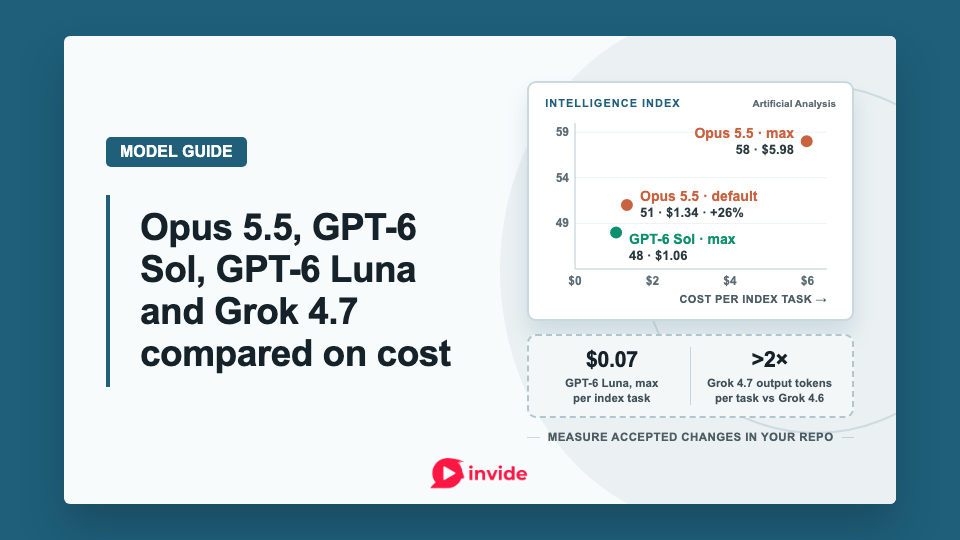
On the Artificial Analysis Intelligence Index, Opus 5.5 at maximum effort scored 58 at $5.98 per task, while Sol at maximum effort scored 48 at $1.06. Opus at medium effort, Anthropic's default, scored 51 at $1.34 per task. At its default setting, Opus outscored Sol's best result for about 26% more per task. These are weighted average costs across ten evaluations. A team still needs to measure how many code changes pass review in its own repository.
What changed in price and access?
These are the vendors' standard API prices for one million tokens at the shorter prompt lengths covered by their base rates. Subscription plans have separate usage limits.
| Model | Input | Cached input | Output | Change from predecessor |
|---|---|---|---|---|
| Claude Opus 5.5 | $4 | $0.20 | $20 | Input and output down 20%; cached input down 60% from Opus 5 |
| GPT-6 Sol | $2 | $0.20 | $10 | Input and output rates down 50% from GPT-5.6 Sol's promotional prices |
| GPT-6 Luna | $0.10 | $0.01 | $0.50 | Input down 50%; output down about 58% from GPT-5.6 Luna |
| Grok 4.7 | $2 | $0.50 | $6 | Same rates as Grok 4.6 |
The Anthropic launch page, OpenAI API changelog and xAI release notes establish the current rates. Luna's predecessor prices, used to calculate the change in the table, come from Artificial Analysis. OpenAI's rates here apply to prompts of up to 272,000 input tokens. xAI charges twice its listed input, cached-input and output rates above 200,000 prompt tokens. Faster service and cache writes can also have different prices.
Opus costs twice as much as Sol for uncached input and output tokens, but both charge $0.20 per million cached input tokens. Reusing a large cached context therefore narrows their input-cost gap. Grok's $6 output rate is lower than Sol's $10, while its $0.50 cached-input rate is two and a half times Sol's. That cache rate works against Grok in agent loops that repeatedly read the same context. Output length and cache writes still affect the total.
Opus 5.5 is available as claude-opus-5-5 through Claude's platform and the major cloud providers. OpenAI's gpt-6-sol and gpt-6-luna are available through its API and are rolling out in Codex and ChatGPT Work. OpenAI says they are not yet in ordinary ChatGPT Chat. Enterprise administrators must enable them, and Free and Go users can access Luna in the desktop app. Grok 4.7 is available as grok-4.7 through the xAI API, Cursor and Grok Build. The Fast variant is limited to Cursor and Grok Build and costs twice the standard token rates, according to xAI's release notes.
Do lower token prices cut the cost of a completed task?
Anthropic says Opus 5.5 costs 40% less than Opus 5 on its typical workloads at default settings, partly because it uses fewer tokens. In Artificial Analysis's launch-day evaluation, cost per task stayed roughly level at maximum effort. Opus 5.5 used about 119,000 output tokens per Intelligence Index task versus about 73,000 for Opus 5.
Sol and Luna came closer to the savings suggested by their rates in Artificial Analysis's tests. At maximum effort, Sol cost $1.06 per Intelligence Index task, compared with $1.99 for GPT-5.6 Sol. Luna cost $0.07 versus $0.18 for GPT-5.6 Luna. Sol used about 31,000 output tokens per task, up from 29,000. Luna used about 51,000, up from 41,000. The evaluator's Coding Agent Index found Sol up two points over its predecessor in Codex, while Luna fell two points.
Grok 4.7 keeps Grok 4.6's token rates, but used about 81,000 output tokens per Intelligence Index task at xhigh effort, against about 38,000 for 4.6 at the same effort, according to Artificial Analysis. The evaluator also found a nine-point gain for Grok 4.7 with Grok Build on its Coding Agent Index.
Artificial Analysis runs its Intelligence Index through a common setup, while its Coding Agent Index includes the agent around the model. Its Opus 5.5 launch report did not include a new Coding Agent Index run.
Which model should a team try first?
For large migrations or difficult debugging, try Opus 5.5 at medium effort first. Anthropic keeps adaptive thinking on for this model. Any thinking tokens it generates count toward the output bill, so set effort with that cost in mind. Anthropic says routine software-development bug finding and fixing remains available, while most cybersecurity tasks route to Opus 4.8 under its safeguards. Security teams should check which model completed a task when assessing results.
Try Sol first for varied repository tasks handled by coding agents when low task cost matters. Use Luna for repeated, focused tasks such as classification or first-pass checks, with review before use. On Artificial Analysis's Coding Agent Index, Luna scored 41 in Codex, 16 points below Sol's 57.
If your team uses Grok Build, trial Grok 4.7 on coding tasks. It scored 56 on the Coding Agent Index in Grok Build, close to Sol's 57 in Codex, though the coding tools differed. At Artificial Analysis's measured token counts for Grok and Sol, output tokens alone would cost about $0.49 per Intelligence Index task for Grok at xhigh effort and $0.31 for Sol at max effort, using standard API rates. Grok's lower output rate per token does not produce a lower output bill in those runs. If you use the xAI API with prompts above 200,000 tokens, apply its higher rates.
Run recent repository tasks through each candidate at a chosen effort level. Record the share of changes accepted after review, input and output tokens, cache reads and writes, retries, elapsed time and the human work needed to finish them.

Member discussion