
AMD's Taalas deal is a bet on dedicated silicon for the right AI models
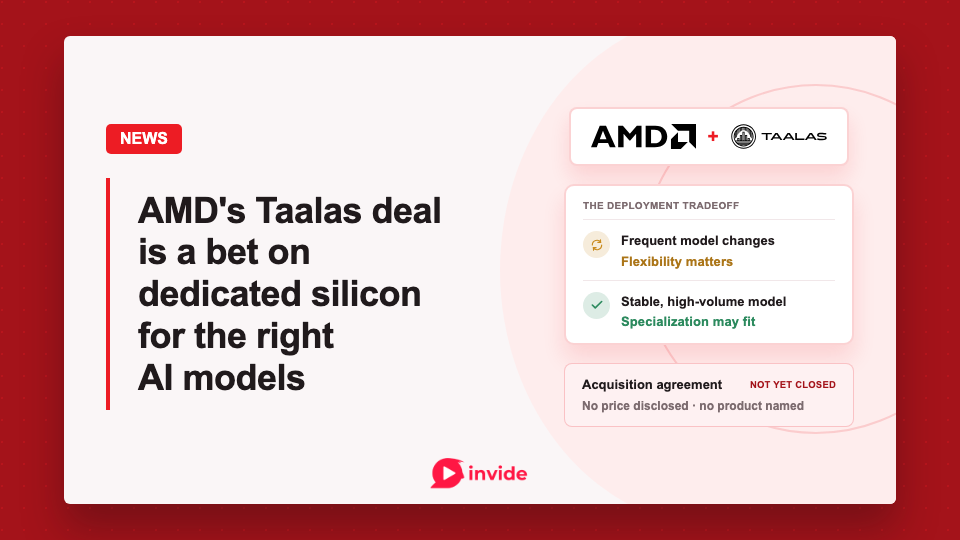
AMD announced a definitive agreement to acquire Taalas on August 6. Taalas builds specialized AI inference silicon around a model's dataflow, an approach AMD says can reduce the compute and memory bottlenecks of general-purpose hardware. AMD plans to bring that technology into its accelerator roadmap alongside AMD Instinct GPUs.
The important word is plans. The acquisition has not closed, a purchase price was not announced, and AMD has not named a Taalas-based product or a date for one. In the Hacker News discussion, commenters have focused on an operational question: will a model remain useful long enough for dedicated hardware to repay its cost? Teams still need programmable accelerators when they train, experiment, or frequently change a serving model. A model that is stable enough, cheap enough, and used often enough may justify hardware designed more narrowly around it.
Specialized silicon has to survive the next model release
AMD describes Taalas as an inference-silicon company that optimizes a model's dataflow. AMD says the approach can reduce compute and memory bottlenecks, and that it expects the technology to complement its broader stack of GPUs, CPUs, ROCm, and rack-scale systems.
For a workload with a long, predictable life, the stated aim is a closer match between an inference dataflow and the hardware that serves it. AMD's announcement offers no benchmark for a Taalas-based AMD product; the supported performance claim is the company's narrower point about compute and memory bottlenecks. The deployment tradeoff will depend on how often a team changes its model and how much it needs flexible infrastructure.
That consideration will vary by deployment. A frontier lab that changes models frequently has a different problem from a company serving a reliable smaller model for document classification, support routing, or a private internal assistant. The latter may value a predictable serving path more than always having the newest capability.
A complement to flexible accelerators
AMD places Taalas alongside the products that already make up its AI platform. The deal fits a mixed approach: programmable accelerators for training and rapid model iteration, then more specialized hardware for a mature, high-volume inference path.
The r/LocalLLM discussion makes that split concrete. Community reactions focus on the appeal of private or edge inference, alongside questions about whether model-specific hardware can be updated once it is made. They expose the adoption test: the model, task, and deployment window need to be stable enough to live with the hardware's constraints.
Inference workloads differ sharply by size, context length, traffic pattern, and how often a team needs to update weights or behavior. The deal leaves a product question: can AMD turn Taalas's work into something developers can buy, program, and operate easily? The Register's reporting adds context on the unusual hardware approach, while AMD's release remains the firm statement about its roadmap.
For now, AMD's Taalas deal is best read as a bet on a more mixed inference future. For developers, the concrete question is whether a specific model is stable, valuable, and predictable enough that giving up flexibility is finally worth it.
Member discussion