
Meta’s Muse Code bets that a coding agent needs durable state, not just a stronger model
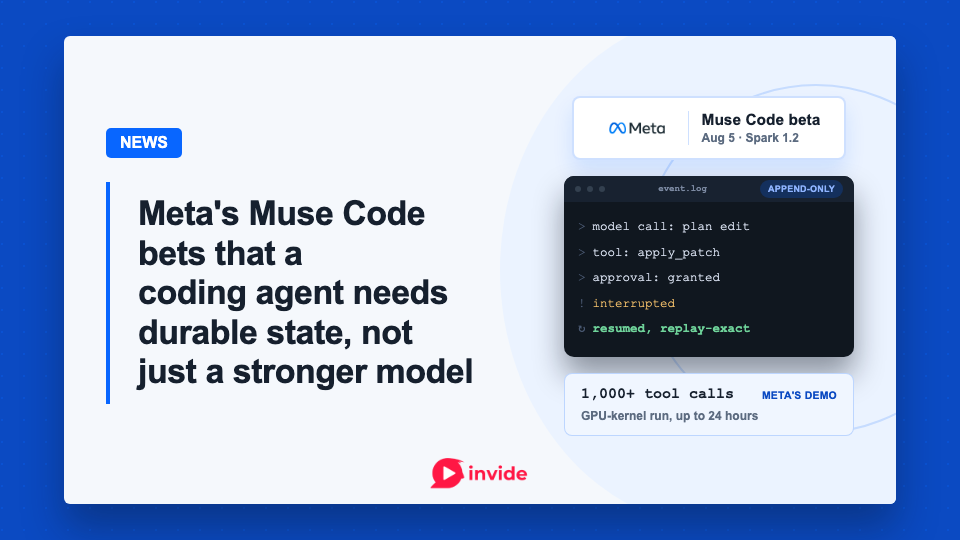
Meta released its Muse Code beta on August 5, alongside its Muse Spark 1.2 model. The terminal coding agent can plan changes, work with tools, and run through a coding task. The more interesting part is what Meta has built around it: persistent background agents and a local append-only event log for model calls, tool activity, approvals, and edits.
That sounds like implementation detail, but it is becoming the real boundary for coding agents that are meant to do more than answer one prompt. A task that runs for hours needs to recover from interruption, retain enough context to avoid retracing its work, and show a developer what actually happened. Meta is treating those requirements as part of the product rather than as a wrapper around a model API.
The agent is designed to keep working after the first task
Muse Code keeps specialized background agents alive through a session instead of creating them afresh for each subtask, according to Meta. The company says its event log makes work replay-exact and restart-safe. If that works as described, the useful benefit is not simply that an agent can take more tool calls. It is that an interrupted run has a record of its decisions and changes instead of an opaque gap between the initial instruction and whatever files are left on disk.
This is the right problem to solve for teams using terminal agents on real repositories. A long task can touch source, tests, configuration, and external tools. The operator needs a way to tell which actions were proposed, which were approved, and where the run stopped. Meta says persistent workers reduce duplicated exploration, but they also make the log and the approval boundary much more important.
Meta's own demonstration is deliberately ambitious. It reports using Muse Code for GPU-kernel optimization runs that made more than 1,000 tool calls over as long as 24 hours. That is useful evidence of the kind of workflow the system targets. It is not evidence that the beta will handle an ordinary production repository reliably for a day, nor does it settle how the approach behaves with sensitive credentials or messy build environments.
The discussion is as much about the service as the agent
The reaction across Hacker News, r/singularity, and r/opencodeCLI quickly moved beyond the agent loop. Developers are weighing price and quality, questioning the benchmark comparisons, and asking what the data-use terms mean for work that may include source code and prompts. Others simply do not want to switch an established Codex or Claude Code workflow to a new service.
Those are reactions, not independent findings about Muse Code. Still, they point to the practical adoption test. A persistent coding agent only helps if a team can understand its service terms, trust its data boundary, and integrate it without redoing the habits that make its current tooling safe. The conversation in r/DeepSeek is especially blunt about that tradeoff: lower cost does not automatically outweigh concerns about what a hosted service can retain or use.
The beta therefore deserves attention less as a verdict on Meta's coding model and more as a clear statement of where terminal agents are heading. The next useful test is whether Muse Code's persisted workers and event history help engineers review, recover, and constrain real multi-step work better than existing terminal agents.
Member discussion