
Nine exploited and high-risk flaws to patch and verify as of November 26, 2026
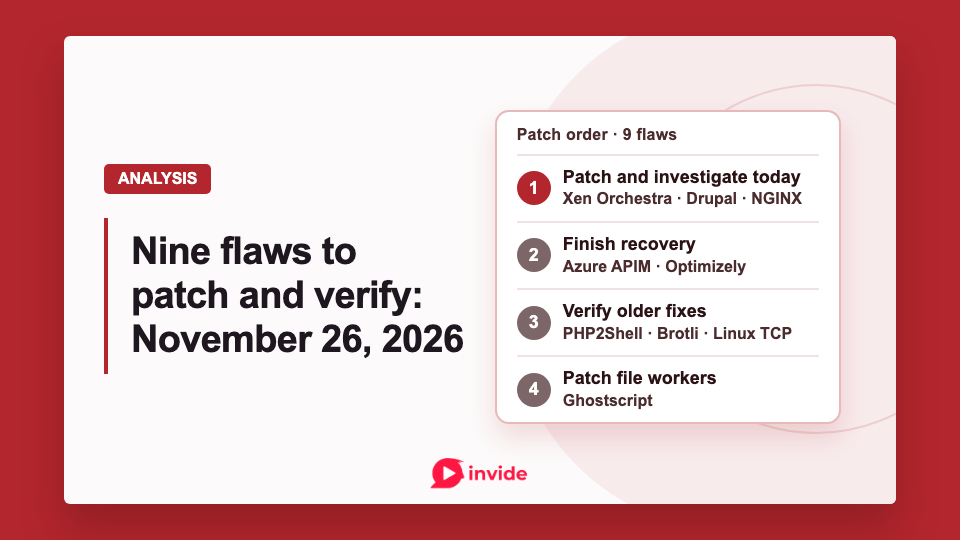
If you run affected Xen Orchestra instances, Drupal sites or NGINX servers with HTTP/2 enabled, patch them today and review them for compromise. Vates reports active exploitation of Xen Orchestra and says fixes have been available since November 10. Whenever you patched, check for compromise before that date, since Vates disclosed the flaw as already exploited. Drupal received a report of attacks on live sites as early as November 19 at 19:00 UTC. On November 25, Drupal reported exploitation of a related flaw that can still affect some sites after the first update. CISA added the first Drupal flaw on November 24 and Xen Orchestra on November 25 to its Known Exploited Vulnerabilities catalog. On November 26, Singapore’s Cyber Security Agency reported that NGINX HTTP/2 flaw CVE-2026-123007 was being actively exploited.
After those urgent patches and investigations, finish recovery for Azure API Management and Optimizely. Then count the production deployments still missing older fixes and patch Ghostscript workers that process untrusted files.
| Flaw | Status | Fix floor | Proof check | Review logs from |
|---|---|---|---|---|
| Xen Orchestra | Exploited | 6.9.2 / 6.10.1 | Running xo-server version |
Before you patched |
| Drupal | Exploited | 11.4.14 / 11.3.23 / 10.6.23 + update.php |
drush status and update completion |
Nov 19, 19:00 UTC |
| NGINX HTTP/2 | Exploitation reported for CVE-2026-123007 | Open Source 1.30.7 / 1.31.9. Plus 37.0.8.1 / 37.3.0.1. | nginx -v or vendor package revision |
Before you patched |
| Azure APIM Classic | Exploited, fixed by Microsoft | Microsoft’s Nov 19 fix | RuntimeVersion and credentials rotated |
Before and after Nov 19 |
| Optimizely | Exploited, fixed by Optimizely | Optimizely’s fix | Pages reviewed | Nov 16 until removal |
| PHP2Shell | Exploited | 8.5.12 / 8.4.27 / 8.3.36 / 8.2.35 | php-fpm -v |
No start date listed |
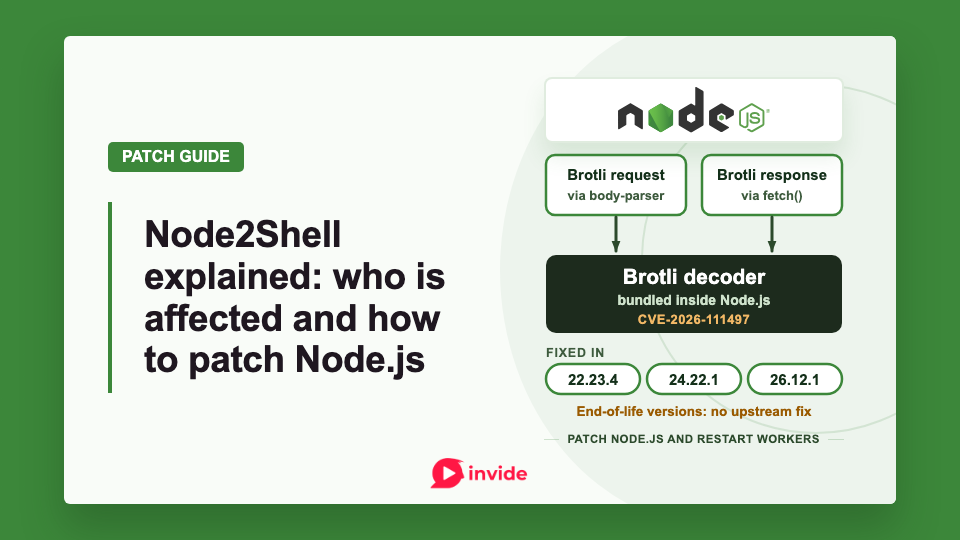
| Brotli | Exploited | Node 22.23.4 / 24.22.1 / 26.12.1. See below for other runtimes. | node -v or vendor package revision |
No start date listed |
| Linux TCP | No confirmed attacks | Per distribution and kernel flavour | uname -r |
No start date listed |
| Ghostscript | Public proof of concept | 10.08.0 or vendor backport | gs --version and package revision |
No start date listed |
Patch and investigate today
Xen Orchestra · CVE-2026-133469. Upgrade to 6.9.2 or 6.10.1 for your channel, with xo-server 5.211.2 or 5.213.1, respectively. Verify the running server version and follow Vates' forensic guidance. Vates says successful exploitation leaves no login record. Review retained HTTP captures for the suspicious authentication-cookie patterns listed in the Vates advisory. Check network records for connections involving 91.211.251.112:8001. Check for a VM named pivot2 and, on XCP-ng hosts, for /etc/cron.d/zz-ustar*, /.ustar5, or /.ustar6. These indicators cover the campaign Vates observed. If you find compromise, Vates recommends reinstalling affected systems. CISA set November 28 as the federal remediation deadline and called for forensic triage.
Drupal Core · CVE-2026-132165 and CVE-2026-136716. The November 25 follow-up advisory reports exploitation and says some sites in unusual or incomplete installation states remain exposed after the first patch. Drupal says sites with a secured installer are protected against the follow-up flaw. Upgrade to 11.4.14, 11.3.23, or 10.6.23 for your branch and run update.php to repair the affected state on existing sites. Secure the installer and use drush status to confirm the deployed version. Move end-of-life branches to a supported release. The interface cannot reliably show whether a site was vulnerable or compromised. Review logs for unexpected changes to or by user 1 and confirm its email address is one you control. Begin review by November 19 at 19:00 UTC, the earliest reported exploitation of the first installer flaw. The federal KEV deadline for that first CVE is November 27.
NGINX HTTP/2 · CVE-2026-123007 and CVE-2026-123633. On November 26, Singapore’s Cyber Security Agency reported active exploitation of CVE-2026-123007 and urged immediate patching. The alert says a public proof of concept is available and gives no exploitation start date. Review available logs from before your patch. CERT-EU’s November 18 advisory describes the research demonstration and the risk of unauthenticated code execution with NGINX worker privileges. Wiz demonstrated CVE-2026-123007 on a server delivering static files over HTTP/2, without a backend application or third-party modules.
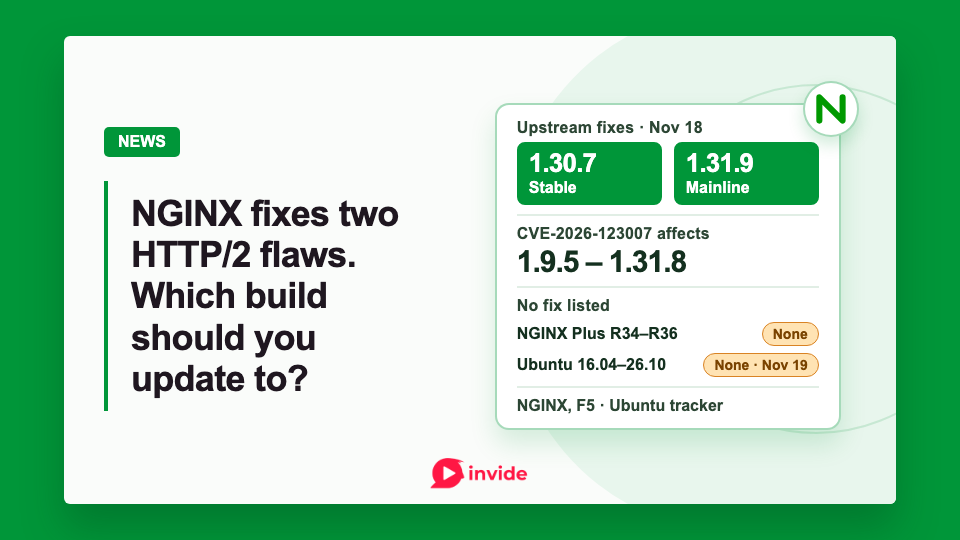
The November 18 upstream fix floors are 1.30.7 stable and 1.31.9 mainline. Prefer 1.30.8 or 1.31.10 or a later fixed build because the November 23 update also addresses the separate TLS CPU issue, CVE-2026-132779. Check which HTTP/2 configurations are affected, then verify the serving binary with nginx -v after rollout. For NGINX Plus, 37.3.0.1 and 37.0.8.1 cover both HTTP/2 flaws on their respective branches. For affected Plus R34 through R36 builds without a listed fix, move to a fixed 37.x release using F5’s upgrade guidance. If you cannot update immediately, disable HTTP/2 on exposed listeners as a temporary mitigation for both CVEs, as CERT-EU advises. Remove the http2 parameter from the affected listen directives or set http2 off;, depending on how HTTP/2 is enabled in your configuration. For distribution builds, compare the package revision with the vendor advisory.
Finish recovery after the Microsoft and Optimizely fixes
Microsoft and Optimizely have closed the flaws. Azure API Management Classic customers still need to rotate credentials that may have been exposed. Affected Optimizely customers need to identify the pages that loaded the injected script.
Azure API Management Classic. Find Service Health advisory MZK9-GH0 for your tenant. Microsoft told BleepingComputer that Classic Developer, Basic, Standard and Premium were affected. It excluded Classic Consumption and all v2 tiers. Norway's security authority reported that an attacker targeted access tokens and secrets. Microsoft says customers were exposed and an attacker could have accessed stored secrets before it identified the flaw. The Service Health advisory dates mitigation to November 19 and says remediation “does not automatically invalidate credentials that may have been accessed before the fix was deployed.” Rotate potentially exposed credentials, confirm the old ones are revoked, and review retained access logs both before and after the November 19 fix for use of those credentials. NSM also advises checking RuntimeVersion at your gateway's /internal-status-0123456789abcdef endpoint against its thresholds. For 0.52.x, the last number must be at least 31936. For 0.53.x, it must be at least 31938. NSM excludes v2 and Consumption builds from those thresholds. That check establishes patch status. Credential recovery still needs its own sign-off.
Optimizely Web Experimentation · CVE-2026-132224. Optimizely says it removed injected JavaScript and contacted every Web Experimentation customer directly. Find your notification and check which pages loaded your snippet from November 16 until the code was removed. Prioritize pages that collect login or payment information. Record the pages reviewed and follow the account-specific guidance. CISA added the exploited flaw on November 24, with a federal deadline of November 27.
Count deployments still missing older fixes
CISA listed both PHP2Shell CVEs on October 26 and the underlying Brotli CVE on October 27. In the Qualys dataset analyzed by the 2026 Verizon Data Breach Investigations Report, roughly 60% to 70% of known-exploited vulnerability instances remained open at day seven. Count the affected production deployments still outstanding, including Linux hosts still running a kernel without the TCP fix.
PHP2Shell · CVE-2026-109618 and CVE-2026-109619. CISA lists both flaws as exploited. The October 21 upstream fixes were 8.5.12, 8.4.27, 8.3.36, and 8.2.35. The November 19 releases for those branches were 8.5.13, 8.4.28, 8.3.37, and 8.2.36. Use a current supported release or a vendor package that includes both fixes. Follow our PHP rollout guide and check php-fpm -v with the same binary used by the serving pool and confirm the workers were replaced. If an upgrade is delayed, session.upload_progress.enabled=0 mitigates the known session paths for CVE-2026-109619. Set it before requests are parsed and restart the workers. Apply the full update to address both CVEs, including CVE-2026-109618.
Brotli · CVE-2026-111497. CISA lists the underlying Brotli flaw as exploited. Node first shipped the Brotli fix on October 21 in 22.23.4, 24.22.1, and 26.12.1. Use a supported build containing that fix. Use our Node deployment checks and run node -v with the same executable the service uses, inside the serving container where applicable. Compare with the fixed release for that branch. For a vendor backport, verify the exact package revision. PHP rebuilt its Windows packages on October 26 as 8.5.12-1, 8.4.27-1, 8.3.36-1, and 8.2.35-1, with Brotli 1.2.1. Check the deployed Windows package revision, especially where cURL automatic response decompression is enabled. PHP says it is off by default. Check your dependency inventory for standalone Google Brotli and bundled copies. The CVE record lists 1.0.10, 1.1.1, and 1.2.1 as fixed releases for their respective branches. Follow Microsoft’s .NET advisory for affected .NET releases and use andybalholm/brotli 1.2.7 or later for that Go library. Check other bindings against their own advisories.
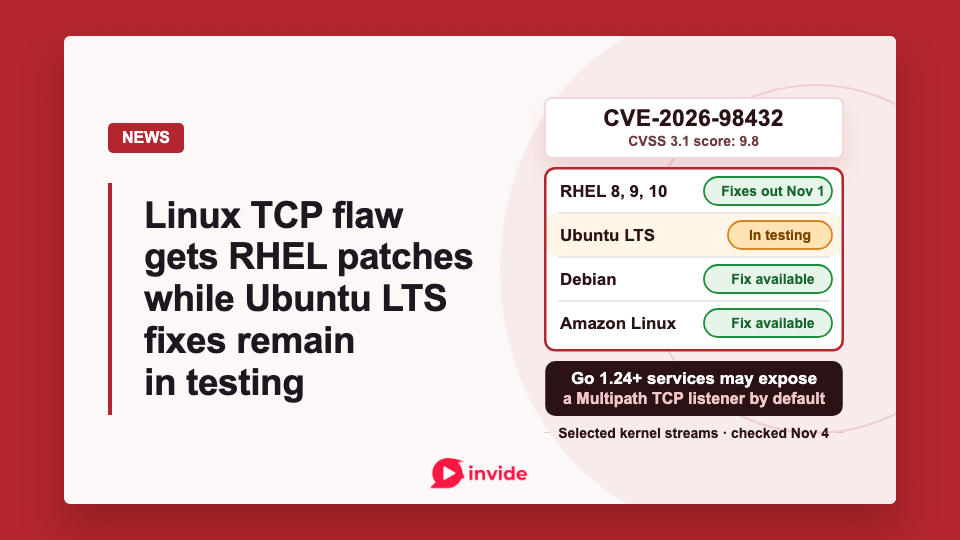
Linux TCP · CVE-2026-98432. Canonical lists these fixes for the generic Ubuntu kernel package: 7.0.0-43.43 on 26.04 LTS, 6.8.0-149.149 on 24.04 LTS, 5.15.0-203.213 on 22.04 LTS, and 5.4.0-247.267 on 20.04 LTS with Ubuntu Pro. Cloud and other kernel flavours have their own entries. On RHEL, Debian and other distributions, check the distribution’s security tracker for the fixed kernel. Our November 4 Linux guide documents the earlier rollout. Reboot after updating and use uname -r to confirm the active kernel corresponds to the fixed package. GreyNoise's report describes testing on the actor's own relay. As of November 26, the sources checked contained no confirmation of successful exploitation of this CVE against a victim.
Patch Ghostscript workers
Prioritize workers that use Ghostscript to process untrusted files.
Upload2Shell · CVE-2026-125396. Public proof-of-concept code exists. Sophos said on November 23 that it knew of no public reports of in-the-wild exploitation. Update workers that process untrusted files to Ghostscript 10.08.0 or later, or use a distribution backport. Run gs --version in the deployed worker and check the actual package revision against the vendor's record if it reports an older version. If the fix must wait, suspend the affected untrusted conversion path. For Render's native Ghostscript, confirm a successful deploy since November 20 at 20:00 UTC. If you bundle Ghostscript or ship it in a Docker image, rebuild with 10.08.0 or later or a fixed vendor package, then redeploy.
Record what still needs work
Bring the outstanding count from the older fixes to the next platform check-in, along with the running version for each patch. The incident owner signs off separately on log review, credential revocation, or project investigation. This November 26 snapshot reflects the advisory and catalog records checked that day.
Member discussion